Author: inmeet_admin

  • What Is a Smart Meeting Room Solution and How It Works

    What Is a Smart Meeting Room Solution and How It Works

    A smart meeting room solution is a single system that connects your booking software, your door access control, and your video platforms. It lets you start meetings instantly without delays or cable clutter.

    Table of Contents

    Introduction

    Picture this scene. It is 10:00 AM on a Tuesday. Your team walks into the main conference room. The wall screen is completely blank. The HDMI cable is missing again. You spend the next ten minutes trying to log into a video app. Meanwhile, a key client waits online, staring at an empty virtual room.

    Traditional meeting rooms simply do not work well for modern hybrid teams. They cause stress. They waste valuable time. They make your company look bad in front of clients. You need tools that just work the second you sit down. This is where smart meeting room solutions step in to fix the mess.

    What Is a Smart Meeting Room Solution

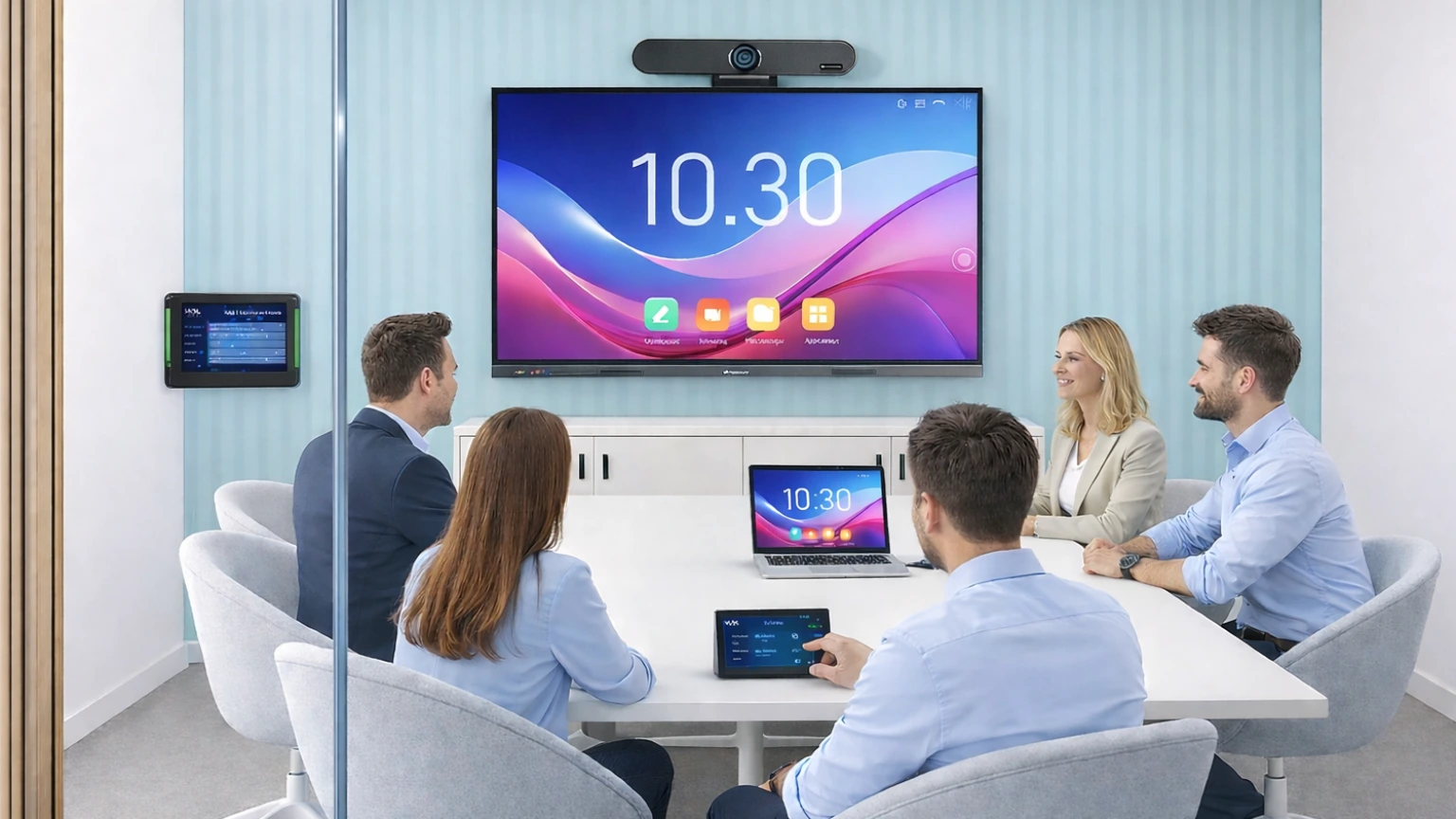
    A smart meeting room connects your booking calendar, your door access, your room controls, and your video calls into one clear experience.

    It removes the daily friction from starting and running your meetings. You do not deal with delays. You do not untangle cables. You do not guess which remote turns on the camera. The system connects everything ahead of time so you can just talk and work. You walk in, press a single button, and your meeting begins. If you want to understand the importance of making this shift, read about why your business needs a dedicated virtual meeting platform.

    Why Traditional Meeting Rooms Fail

    Old rooms rely on standalone pieces of hardware that do not connect with each other. This causes daily problems that frustrate your staff and slow down your work. Let us look at the main roadblocks.

    • Double bookings: Two different teams show up for the exact same room at the exact same time. Both teams think they booked it. They stand in the hallway and argue over the space.
    • Delayed meeting start: People fight with broken cables. They type in long passwords using a cheap keyboard. They spend time fixing tech instead of talking about real work.
    • Too many devices and remotes: You need one remote for the TV. You need another remote for the camera. You need a third remote to change the volume. It is too confusing for most people.
    • Platform compatibility issues: The room hardware only runs Zoom. However, your client uses Microsoft Teams. You cannot connect the call on the main screen.
    • No visibility into room usage: Teams book rooms for weekly meetings but sometimes do not show up. The room sits empty, but the calendar says it is full. Managers have no idea if teams actually use the spaces they book.

    Real Example: A sales team at a growing software company lost fifteen minutes of a major pitch. They could not share their laptop screen to the wall TV. They tried three different cables, but none worked. The team lost a major deal simply because of bad room hardware.

    Key Components of a Smart Meeting Room

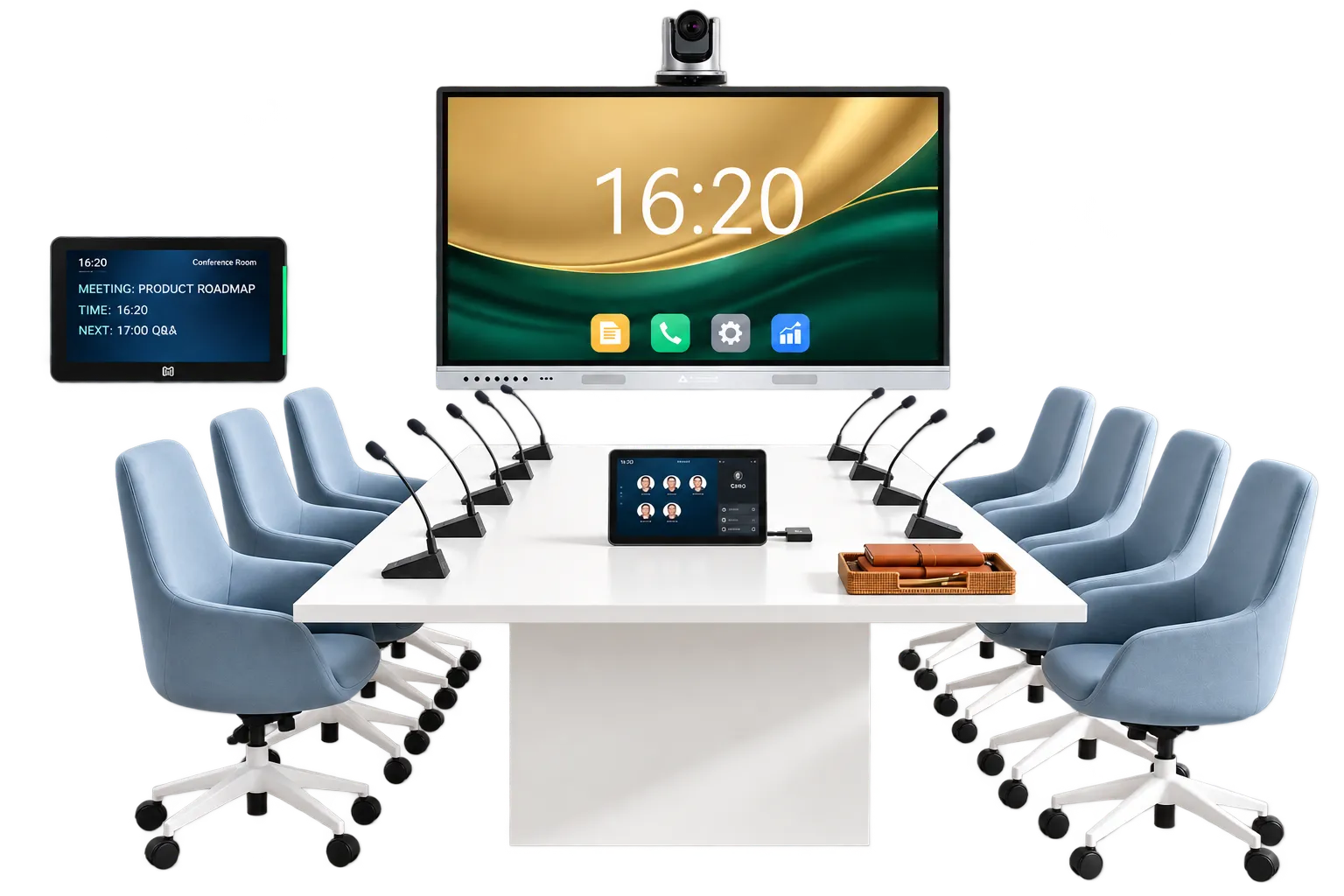
    A smart room uses an ecosystem of tools working together. You need four main parts to make the room smart.

    1. Room Booking System

    Room Booking System

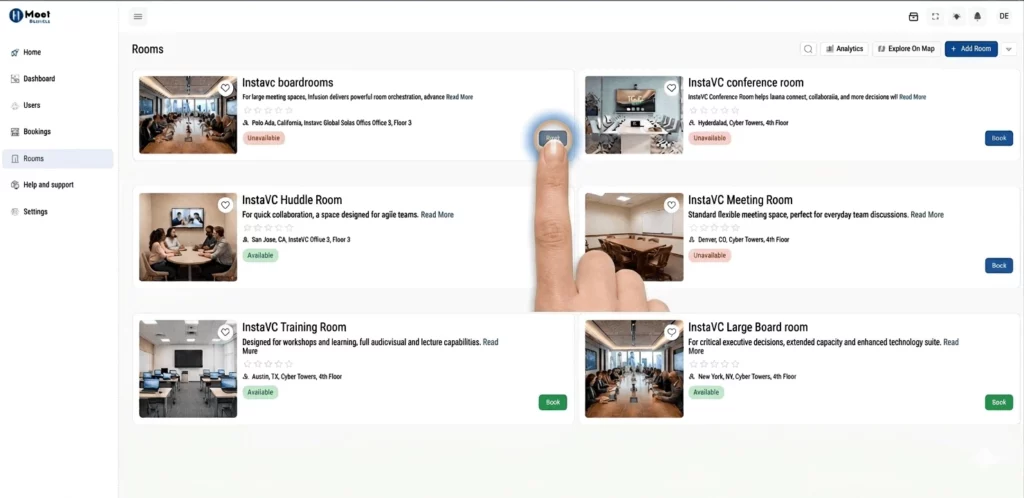
    This software links directly to your company calendar, like Google Workspace or Microsoft Outlook. You book a space right from your phone or your laptop.

    If someone cancels a meeting, the system instantly frees up the room on the calendar. Other people can book it right away. This stops the problem where rooms sit empty.

    Outcome: Meetings start on time, and you always find an open room.

    2. Gateway (Access Control)

    Gateway (Access Control)

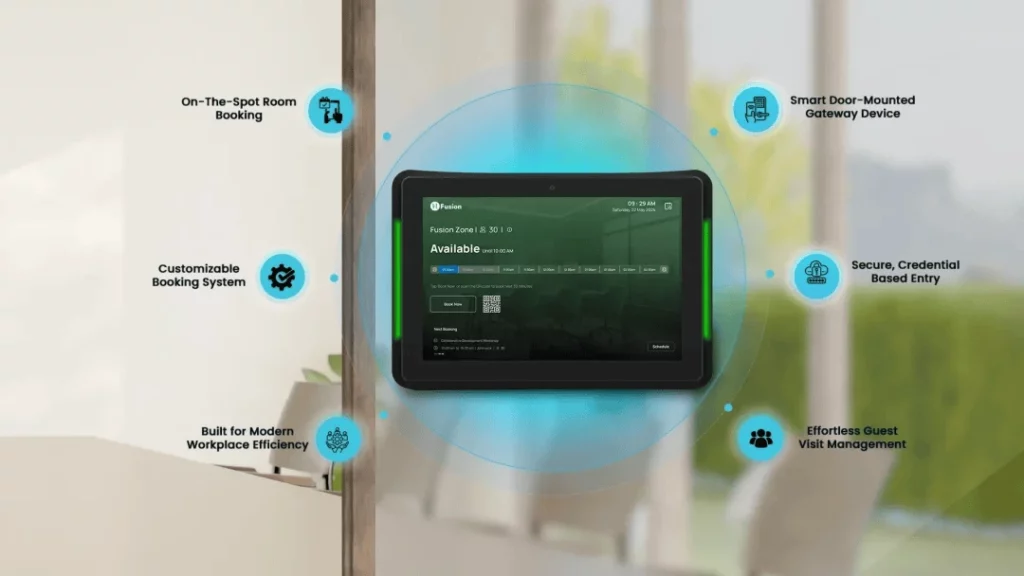
    This is a small, digital screen placed on the wall just outside the meeting room door. It clearly shows the name of the meeting, the time, and who booked it.

    You enter the room using a quick QR code scan on your phone, a typed PIN, or secure face recognition. This keeps private meetings secure. For more details on keeping your data safe, explore the top security features to check before choosing a video meeting platform. Access control stops people from opening the door by mistake and interrupting a serious conversation.

    Outcome: Only the right people use the room, and meetings stay private.

    3. Room Controller

    Room Controller

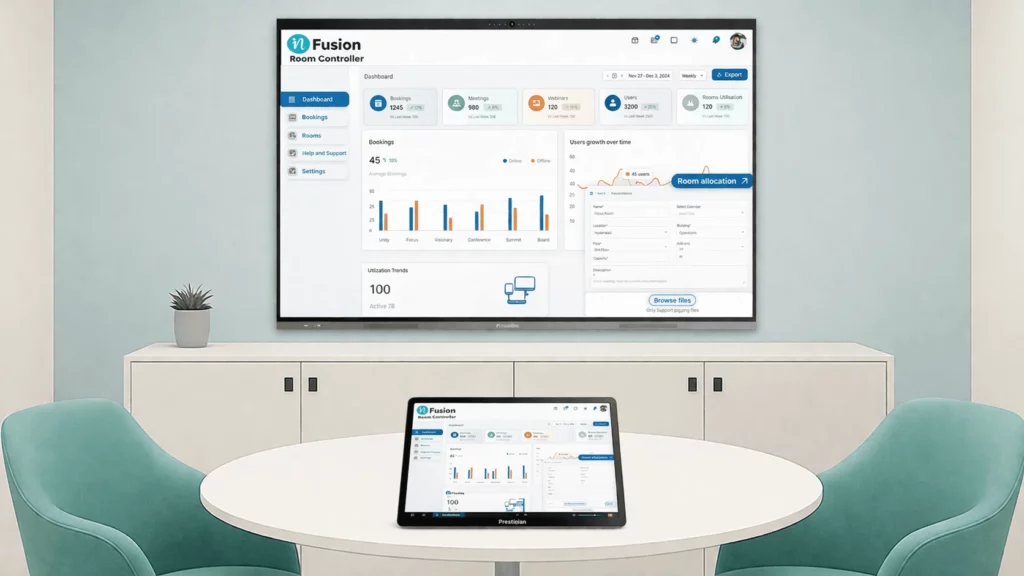
    A single touch screen sits flat on the meeting table. It replaces all the old remotes and keyboards. You use this one screen to control everything in the room.

    You tap it to change the speaker volume. You tap it to move the camera. You tap it to pick different screen layouts. The buttons are big and clear so anyone can use them.

    Outcome: No confusion inside the meeting room.

    4. Meeting Room Hub

    Meeting Room Hub

    This is the brain of the room. It usually hides out of sight behind the main TV screen. It connects all the separate parts together.

    It links the camera, the microphones, the speakers, and the controller. It connects directly to top tools like the InstaVC video collaboration software, Zoom, and Teams. It handles all the heavy processing so your calls run smoothly without crashing.

    Outcome: One unified system for all your meetings.

    How It All Works Together

    The whole process flows in simple, clear steps. The technology stays completely out of your way.

    1. Book the space: You schedule a meeting on your normal Google or Outlook calendar. You add the room to the calendar invite.
    2. Enter using secure access: You walk up to the room. You check the door screen. You scan your personal code to unlock the door and walk in.
    3. Control the room from one panel: You sit at the table. The controller screen shows a big button that says “Join.” You tap the screen once to join the video call.
    4. Start and run the meeting: You share your laptop screen wirelessly to the TV. You do not plug in any cables. You get straight to work.
    5. End the meeting: You tap “End Call” on the table screen. The system resets itself for the next group.

    Want to stop fighting with broken cables and lost remotes? [Book a personalized demo] to see how easy room control can be.

    Benefits for Different Users

    Different groups in your company will notice different improvements right away.

    • For Employees: You start your meetings much faster. You walk in, tap a button, and start talking. You do not worry about technology failing in front of clients. Your daily stress levels drop.
    • For IT Teams: You get far fewer help tickets. People stop calling you in a panic to fix the TV. You manage all the room devices from your own desk. You push software updates to every room in the building at the exact same time.
    • For Management: You see real data on how teams actually use the office. You know which rooms stay empty. You use this solid data to make smarter choices about workspace costs and improve overall team output.

    Real Business Impact

    A smart setup saves your team hours of wasted time every single week. When meetings start on time, people stay focused. It cuts the cost of buying separate gadgets from different brands that refuse to connect with each other.

    Most importantly, it improves the actual meeting experience. People focus better when the tools work. According to a recent report on hybrid work by Gallup, giving teams the right workspace tools directly boosts their daily productivity. Good tools make good work possible.

    When Should You Upgrade to a Smart Meeting Room

    You need to upgrade your office meeting spaces if you notice these exact signs:

    • Your team is growing fast and people fight for open space.
    • You manage multiple meeting rooms and cannot keep track of the hardware.
    • Your staff works in a hybrid setup, mixing office days and work-from-home days.
    • You hear complaints every week about frequent meeting delays.
    • You find dead cables, missing remotes, and broken adapters on the tables.

    If you spot these clear signs, your current setup holds your team back. It is time to make a change. Check out our guide on how to choose secure video conferencing for business to plan your next exact steps.

    Conclusion

    Work meetings should be simple. They should be efficient. Your team needs to focus on big ideas, not broken software and missing TV cables.

    A smart meeting room solution brings everything into one connected system. It takes the frustration out of the workday. It allows your staff to share ideas clearly, whether they sit in the room or join from home. It helps you get back to doing great work.

    Ready to build a better workspace and stop daily meeting delays? [Reach out to our experts today] to get started.

    Frequently Asked Questions

    FAQ
    Do I need to replace all my old equipment?

    You usually do not need to throw everything away. A smart meeting room hub can often connect to the TVs and cameras you already own. You just add the missing pieces, like a room controller or a booking screen, to tie it all together.

    Is it hard for staff to learn how to use?

    Not at all. The main goal of a smart room is to make things easy. If your team knows how to tap a tablet screen or scan a quick code on their phone, they can use the room right away. There is no long training needed.

    Does the system work with both Zoom and Microsoft Teams?

    Yes. A good smart meeting room setup lets you join calls on any major video platform. You do not have to worry about what software your clients or guests use. You sit down, tap the screen, and the system connects the call automatically.

  • What Is a Breakout Room? A Simple Guide for Better Meetings

    What Is a Breakout Room? A Simple Guide for Better Meetings

    A Breakout room is a private, smaller space created inside a main online meeting platform. The host splits a large group into small teams for focused talks. When the timer ends, the system brings everyone back to the main room automatically.

    Table of Contents

    What Does Breakout Room Actually Mean?

    Many new remote workers ask what happens when their manager says it is time to use breakout rooms. You might feel confused. You might wonder if you need to hang up, open your email, and find a new meeting link. You do not need to do any of that.

    In a virtual meeting, you stay right where you are. The host uses built-in tools to divide the main group. The software does all the heavy lifting. A small box might pop up on your screen asking you to join a room, or the software might move you there on its own.

    Suddenly, the large meeting with 40 people turns into a small video call with just three or four coworkers. You can talk, share ideas, and work on a clear task. When the time is up, the software pulls you back to the main meeting. You do not click anything. You do not type in a new web address. It happens in seconds.

    According to industry standards, moving 50 people into small rooms can take less than 10 seconds. You save time, keep your team focused, and avoid the mess of lost meeting links.

    Breakout Room vs. New Meeting Link

    FeatureBreakout RoomNew Meeting Link
    ProcessAutomatic transfer by the system.Hang up, find a new link, and join again.
    Host ControlHost sets up and controls all rooms at once.Host cannot manage multiple links easily.
    Time UsedTakes seconds to move everyone.Wastes valuable meeting time.
    Return TripOne click or an automatic timer brings you back.Hang up and then rejoin the original link.

    Skip the manual work. Try our tool for free

    The Main Reasons Teams Use Breakout Rooms

    Large groups make it hard for everyone to talk. Think about a meeting with 30 people. Three people do all the talking. The other 27 people sit in silence. Some people hide. Others check their phones. Large meetings drain energy and slow down real work. Small rooms fix this problem.

    According to Harvard Business Review, the most productive meetings have fewer than eight people. When groups get larger than that, people stop sharing their best ideas. Research indicates that groups of four to five people share 40% more ideas than large groups of 20 or more.

    Here is why successful teams rely on these small digital spaces every day:

    • More Talking and Less Hiding: People feel safe sharing ideas in groups of three or four. The quiet workers find their voice. Everyone gets a chance to speak without talking over someone else.
    • Fast Choices: Small teams make choices much faster than large teams. They focus on the exact task, look at the facts, and get the work done without endless debates.
    • Easy Teamwork: Teams can look at documents together without stopping the main meeting. They can solve a tough problem in ten minutes instead of sending emails for three days. You can see exactly how these simple tools help teams get more done in our guide on 5 ways virtual meetings improve productivity.
    • Better Focus: With fewer people in the room, distractions drop. Everyone must take part in the task. You cannot hide in the back of the room when there are only four people on the screen.

    Need help implementing this strategy? Book a demo

    The Best Ways to Run a Breakout Session

    You cannot just send people into rooms and hope for the best. Good leaders plan these sessions. If you send a group into a room without a goal, they will talk about the weather. You waste time.

    Research from MIT Sloan Management Review shows that clear rules help remote teams build trust and work better together. You must give your team clear steps before you split them up.

    Follow these steps to run a perfect session:

    Set a Clear Goal

    Tell everyone exactly what they need to do before they leave the main room. Do not be vague. Say, “You have ten minutes to pick the top three ideas for the new project.” Write the goal in the chat so everyone can see it when they move to their small rooms.

    Assign Simple Roles

    Give people jobs. Tell each group to choose one person to watch the clock. Tell them to pick another person to take notes. Pick a third person to share the group’s ideas when everyone goes back to the main room. This gives the group a fast start.

    Set a Strict Timer

    Do not leave the rooms open forever. Give teams a tight deadline. A five-minute or ten-minute timer makes people work fast. Most online meeting platforms let the host set a timer that everyone can see on their screens. When the timer hits zero, the software brings everyone back.

    Keep the Rooms Safe

    When you split people up, you want to make sure the meeting stays secure. Only invited guests should be able to join these rooms. You want to lock the doors to outsiders. Read more about how to protect your company calls in our post about the top security features to check before choosing a video meeting platform.

    Common Mistakes to Avoid During Breakouts

    Even with good plans, hosts make mistakes. Avoid these common traps to keep your meetings running smoothly.

    • Making Groups Too Big: Do not put ten people in one room. This creates the same problem as the main meeting. Keep the groups to three, four, or five people at most.
    • Forgetting to Check In: Do not leave your teams alone for the whole time. As the host, you can send broadcast messages to all rooms. Send a quick message that says, “Halfway done!” or “Two minutes left!”
    • Skipping the Review: When everyone comes back to the main room, you must ask what they learned. If you skip this step, people will feel like the small session was a waste of time. Ask the note-taker from each group to share one big idea.

    Want to see this in action? Book a personalized demo.

    How inMeet Makes Your First Breakout Session Easy

    Using an online meeting platform should feel simple. You should not need a manual to run a meeting. With inMeet, you can click a single button to start your first breakout session.

    You stay in full control. You can pick exactly who goes to which room by dragging their names. If you want to mix things up, you can click a button to let the system assign people randomly. This helps team members meet people they do not talk to every day.

    As the host, you can jump in and out of different rooms to check on the teams and answer questions. It works just like walking around a real office.

    We also keep your company talks safe from outsiders. We build our tools with tough security rules. You can learn more in our full guide on how to choose secure video conferencing for business.

    Conclusion

    Large meetings do not have to be a waste of time. When you use a breakout room, you give everyone a chance to speak, share ideas, and do real work. You stop the awkward silence of a 40-person call and replace it with focused, small-group teamwork.

    The best part is how simple the technology makes this process today. You do not need to pause your virtual meeting, send out new calendar invites, or lose track of your team. The software handles the movement, the timers, and the return trip automatically.

    By adding these short, private sessions to your weekly schedule, your team will make faster choices and build stronger habits. If you want to run better meetings today, start using small groups to get big results.

    Ready to try smaller group chats? To see how simple it is to start a breakout room in inMeet. Book a demo

    Frequently Asked Questions

    FAQ
    What is the main goal of a breakout room?

    The main goal is to let small groups talk in private during a large event. Big meetings make it hard for everyone to speak. These small rooms help people focus, share ideas, and solve problems without talking over each other. They turn a boring lecture into active teamwork.

    How do you start a breakout room?

    The meeting host clicks the breakout button on their main screen. They type in the number of rooms they want to make. They choose if they want to group people manually or randomly. Then, they click start. The software moves the guests automatically in just a few seconds.

    Why use them instead of just making a new call?

    They save a lot of time and stop confusion. Guests do not need to search their email for new links or type in new passwords. The host keeps everyone in the exact same main event. This makes it very easy to bring everyone back together at the end to share what they learned.

  • Video Conferencing Software Costs: Why Host Licenses Are Draining Your Budget

    Video Conferencing Software Costs: Why Host Licenses Are Draining Your Budget

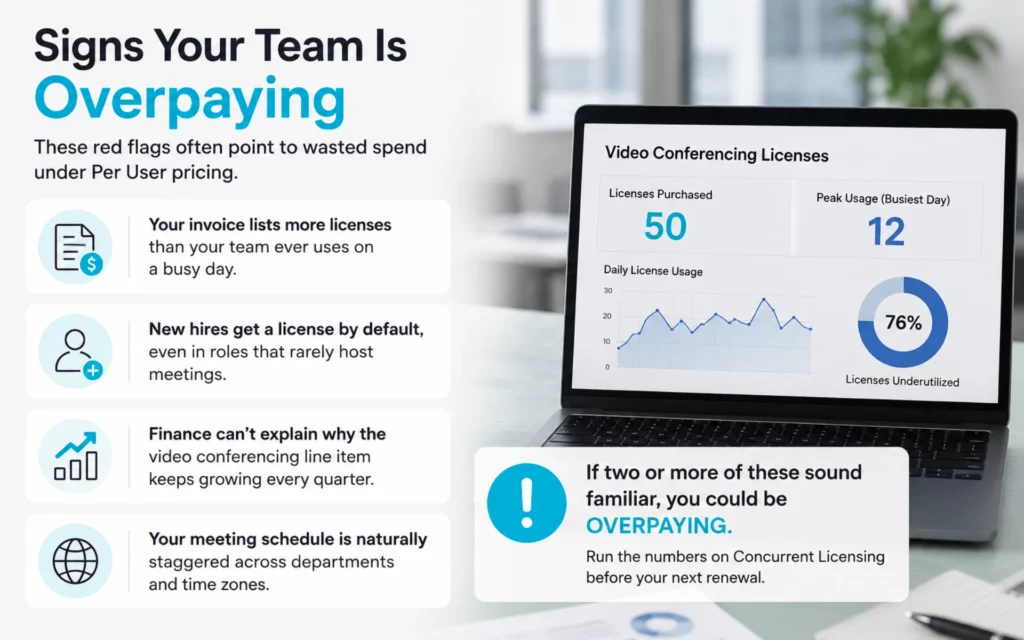
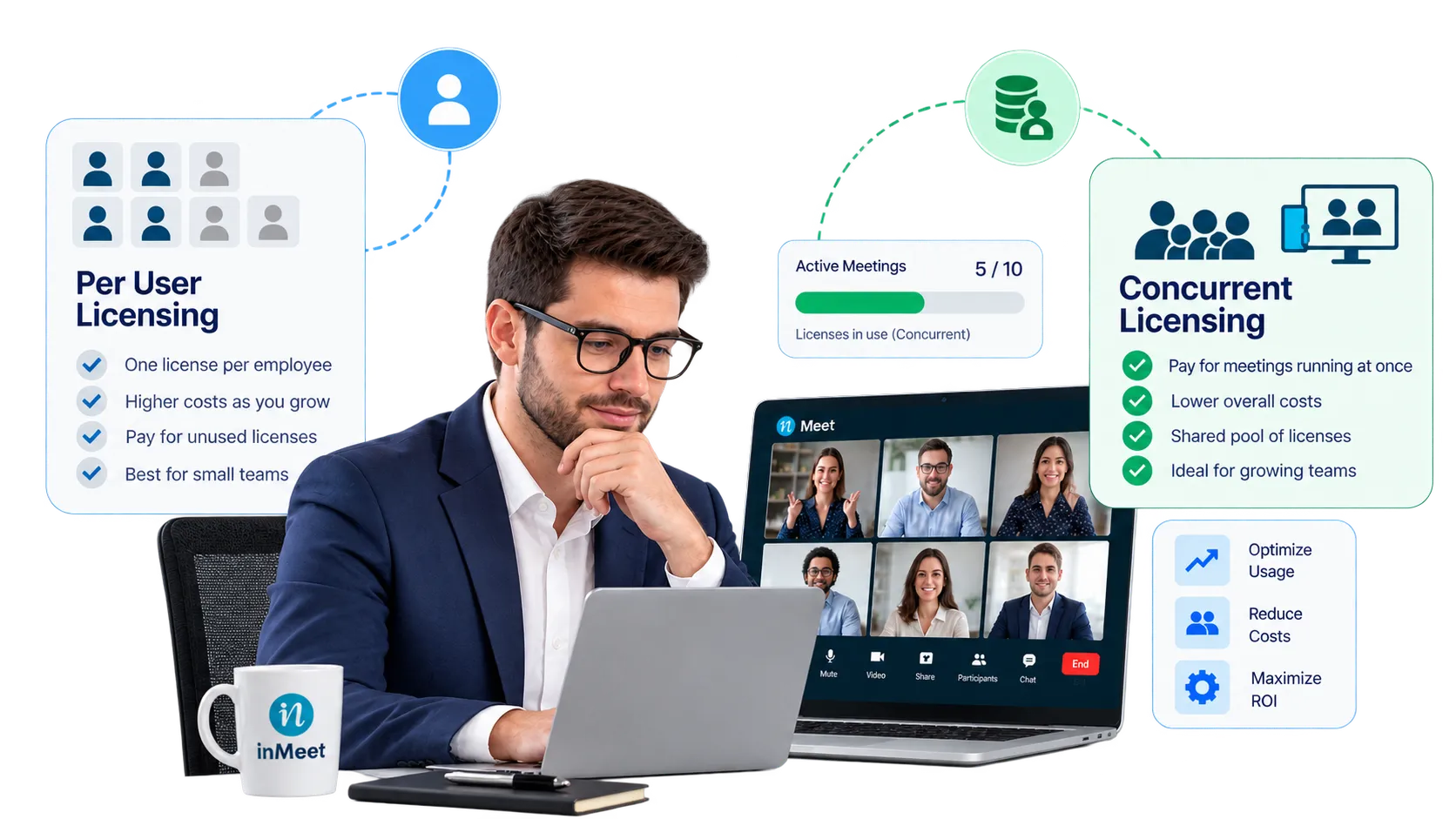
    Host license assigns one paid account to one specific person. You pay for the license even when that person is not in a meeting. A shared concurrent license saves money because a team shares a group of active meetings and eliminates unused account fees.

    Table of Contents

    1. How Host Billing Costs You More
    2. The Real Cost of Unused Software
    3. Understanding Concurrent Licenses
    4. Host-Based vs Concurrent Licensing
    5. Benefits of Concurrent Licenses
    6. How Shared Accounts Work
    7. Impact on Team Productivity
    8. Security and Budget Protection
    9. Steps to Change Your Meeting Software
    10. Conclusion
    11. Frequently Asked Questions

    John runs a marketing agency with two hundred employees. He bought two hundred user accounts for his virtual meeting software. He paid full price for every single employee every month. Last month, John checked his software usage report. He found a massive problem. Only forty employees hosted meetings on a regular basis. One hundred and sixty employees never started a single meeting. They only joined meetings that other people created.

    John realized he paid thousands of dollars for accounts his team never used. He paid for inactive software. John called his software provider. He asked them to change his billing plan. The provider refused. They told John he had to buy one license for every employee who might need to host a meeting in the future. John felt trapped. Many business owners face this exact situation today. They buy traditional host licenses and waste money every month. They do not realize they have a better choice. Stop paying for empty seats today.

    Contact us to learn how inMeet solves this exact problem for businesses.

    How Host Billing Costs You More

    Many companies spend too much money on Video Confrencing Software. They buy traditional host licenses. A host license connects to one specific email address. Only the owner of that email address can start a meeting. If your company has five hundred employees, you buy five hundred host licenses. This costs a lot of money every month.

    Software providers make large profits from these host models. They rely on customers buying too many accounts. They charge a high monthly fee for each account. Companies pay the fee to ensure every employee has access. This creates a financial loss. Companies must stop buying individual accounts for every single employee in the office. They must understand how software companies bill them. They must demand fair pricing. Take action now and count exactly how many employees actually host meetings.

    The Real Cost of Unused Software

    Business leaders often ignore the total cost of their virtual meeting software. Research indicates that forty percent of employees host less than one meeting per week. You still pay full price for these inactive employees. According to industry standards, companies waste thirty percent of their software budget on unused licenses.

    Employees only spend a few hours a week on an online meeting platform. The rest of the time, those paid licenses remain unused. You lose money every hour a license goes unused. You can review technology management research from Gartner to see how businesses struggle with technology costs. You must track your spending carefully. You must check your software accounts every month to stop this financial waste. Calculate your wasted software spending today to see how much money you can save.

    Understanding Concurrent Licenses

    You fix this problem with a concurrent licensing model. A concurrent license creates a shared group of meeting accounts. Anyone on your team can log in and start a meeting. You only pay for the meetings that happen at the exact same time. If you have five hundred employees but only fifty meetings happen at once, you only buy fifty concurrent licenses.

    This approach instantly reduces your monthly bill. You share the software access across the entire organization. This method gives you maximum value for your money. You stop paying for unused accounts. Technology management resources like CIO report on the financial problems of poor software planning. A concurrent model solves this planning problem completely. It aligns your software costs with your actual software usage.

    Host-Based vs Concurrent Licensing

    FeatureHost-Based LicenseConcurrent License
    License OwnershipThe company attaches the license to one specific email address.The company buys a shared pool of seats for the entire team.
    Meeting AccessOnly the specific owner of the email address starts a meeting.Anyone on the team starts their own meeting with shared login details.
    Simultaneous MeetingsOne license allows only one active meeting at a single time.Multiple people run completely different meetings at the exact same time.
    Cost StructureHigh cost because the company pays for inactive users.Low cost because the company buys a small number of shared licenses and pays only for actual use.
    Employee FairnessLimited access causes delays for team members.The shared system gives any employee access to host a meeting instantly.
    Video QualityStandard video quality.The platform supports up to 4K Ultra HD resolution for clear pictures.
    Camera SupportLimited to one single camera.Users connect multiple cameras at the same time.
    Software InstallationRequires downloading specific applications.The software works directly inside the internet browser without downloads.
    Storage LocationLocked to a public cloud network.Users choose the public cloud or install the software inside a private company network.
    Visual CustomizationOlder platforms block custom background colors and logos.Highly customizable interface matches your specific company brand.

    Benefits of Concurrent Licenses

    • Reduces monthly software bills immediately
    • Allows all employees to host meetings
    • Provides high value for your money
    • Eliminates unused account fees
    • Scales easily as your business grows
    • Reduces administrative work for IT departments
    • Makes cost tracking simple and clear

    How Shared Accounts Work

    A concurrent model works smoothly for large teams. An employee wants to host a meeting. They open the inMeet platform. They click a button to start the session. The system checks the shared group of licenses. It assigns one active license to that employee.

    When the meeting ends, the license goes back into the shared group. Another employee can use it immediately. You do not have to wait for approval. You do not have to borrow an account from a manager. The process is fast and simple. Every employee gets the tools they need. The company pays a much lower price for the entire system. Start your transition to a concurrent system today.

    Book a demo of inMeet to see how much money your company will save this month.

    Impact on Team Productivity

    A good virtual meeting software gives you great features without the high cost. Employees can host meetings easily. They do not have to wait for a manager to open a meeting room. This setup helps teams work better together. You can learn 5 ways virtual meetings improve productivity to understand the benefits.

    Teams talk more often when the software is easy to use. They solve problems faster. They share ideas clearly. A shared license empowers every person in your office. Everyone can start an important discussion instantly. The business moves faster when communication tools are available to everyone.

    Security and Budget Protection

    You must keep your meetings safe. When you change your licensing model, you still need strong protection. You must protect your data and your money at the same time. Review the security features to check before choosing a video meeting platform.

    Secure platforms encrypt your conversations. They stop unwanted guests from joining your calls. A concurrent license does not reduce your security. It only reduces your costs. You still get enterprise security features. You still control who enters your online meetings. You can read about how to choose secure video conferencing for business to protect your company. Security and cost savings work together perfectly in a concurrent model.

    Steps to Change Your Meeting Software

    Changing your online meeting platform takes planning. First, you calculate your current costs. You identify how many host licenses you buy right now. Second, you calculate your active meetings. Third, you compare the prices. You will see a large price difference. Look at your usage reports right now and find your maximum daily meetings.

    Finally, you choose a new provider. You deploy the new software to your team. You train them on how to use it. Modern platforms are very simple to learn. Your team will adapt quickly to the new shared system.

    Conclusion

    Host licenses waste your software budget. They force you to pay for unused accounts. You lose money every month. A concurrent license solves this problem. You buy a shared group of licenses. You only pay for active meetings. This model lowers your costs. It gives your entire team access to the software. You get better value for your money. You improve your team collaboration. You must evaluate your software spending today. Switch to a concurrent model to save your budget. You will see the financial benefits in your very next billing cycle. Are you ready to upgrade your communication tools and lower your costs?

    Book a demo right now to start your journey with inMeet.

    Frequently Asked Questions

    FAQ
    What is a host license?

    A host license gives meeting rights to one single user. The company pays a full monthly fee for that one user. No other employee can use that account to start a meeting.

    How to lower video meeting costs?

    You lower costs by switching from host licenses to concurrent licenses. You count the maximum number of meetings your team runs at the same time. You only buy that number of licenses. You share them across the whole company. Evaluate your licensing model today to stop losing money.

    Why do concurrent licenses save money?

    Concurrent licenses save money because they remove unused accounts. You do not pay for employees who are not using the system. You only pay for the active software use.

    What is a concurrent license?

    A concurrent license is a shared software account. A company buys a small number of these accounts. Any employee can use an available account to host an online meeting.

    How to track software usage?

    You can use admin dashboards to see active meetings. You count the highest number of daily meetings. This number shows you exactly how many concurrent licenses you need.

  • 7 Strategic Advantages of Having a Dedicated Telehealth Video Platform

    7 Strategic Advantages of Having a Dedicated Telehealth Video Platform

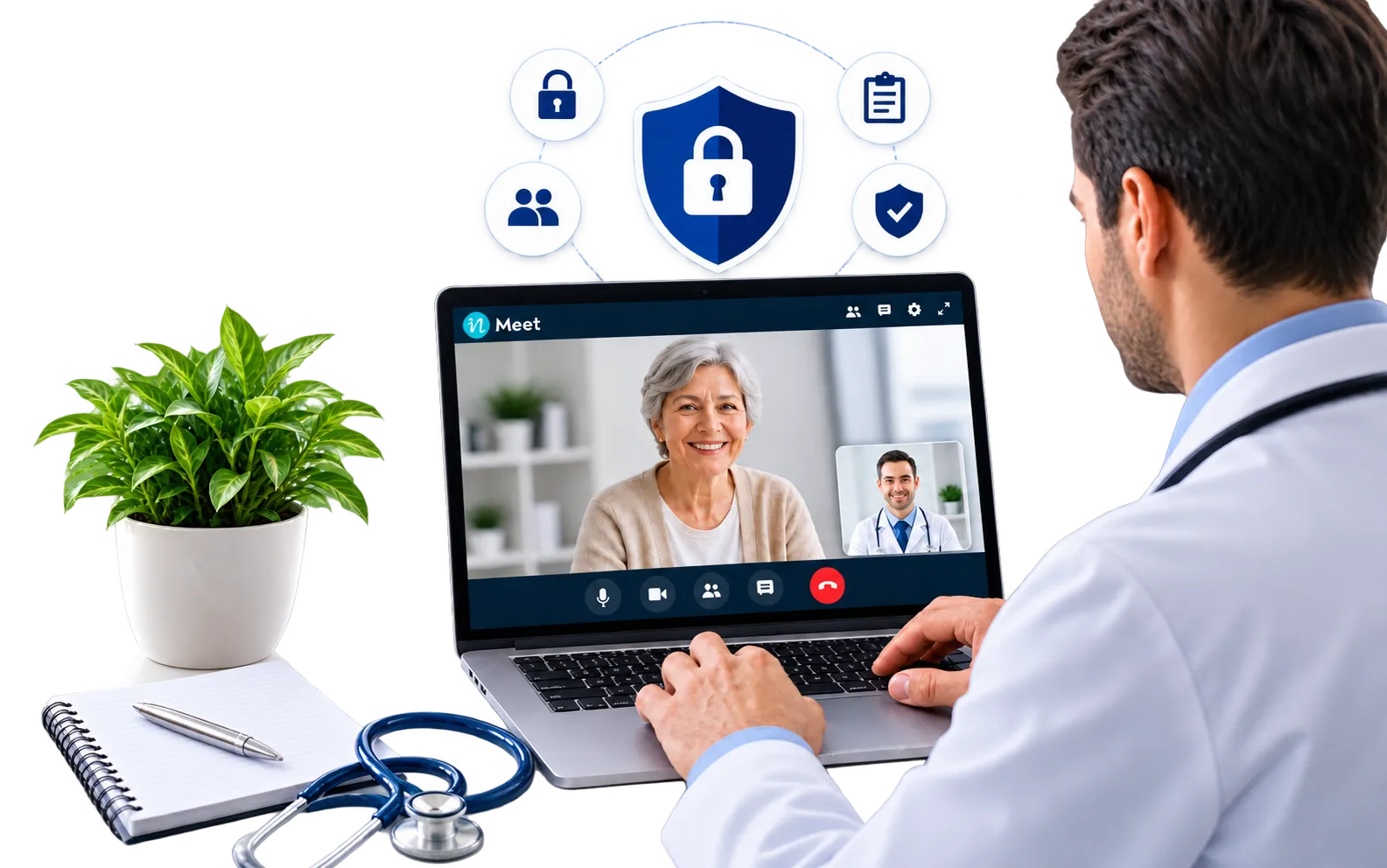
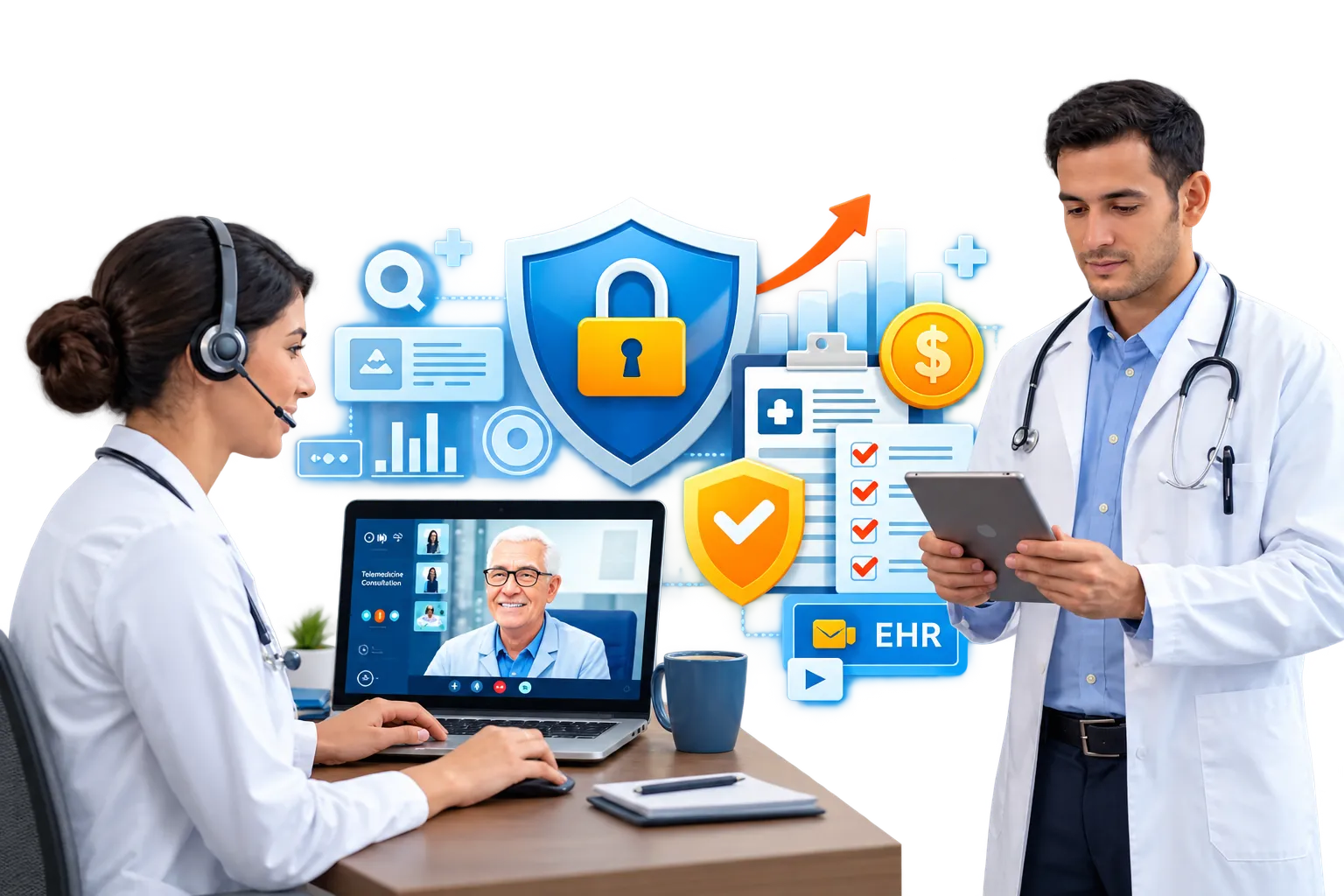
    A dedicated telehealth video platform is a specialized, secure video system made just for healthcare. Unlike regular video apps , it connects directly to your patient records, follows all privacy laws (HIPAA), and includes special tools like virtual waiting rooms to make online visits smoother and safer for everyone.

    Table of Contents

    1. Better Security and Patient Privacy (HIPAA)
    2. Connects Directly with Your Patient Records (EHR)
    3. Looks More Professional and Builds Trust
    4. Tools Built Specifically for Doctors & Nurses
    5. Saves Money and Reduces Admin Work
    6. Gives You Better Data on Patient Visits
    7. Easier for Patients (No App Downloads Needed)

    Why Regular Video Apps (Zoom/Skype) Are No Longer Enough

    The days of using “good enough” video tools are over. When the pandemic started, doctors used whatever worked—Skype, WhatsApp, or FaceTime. But now, those tools are causing problems.

    • It’s Growing Fast: According to Global Market Insights, the telehealth market is projected to skyrocket to over $403 billion by 2034. Patients now expect a professional experience, not a glitchy phone call.
    • Doctors Prefer It: Recent data from the American Medical Association shows that in 2024, 71.4% of physicians reported using telehealth weekly. It’s no longer just an emergency fix; it’s a standard way to see patients.
    • Privacy Risks: Governments are cracking down on privacy leaks. Using a free app can now lead to huge fines if patient data isn’t 100% secure.

    If you are still sending patients a random meeting link, you are missing out on these seven strategic advantages.

    7 Strategic Advantages:

    1. Better Security and Patient Privacy (HIPAA)

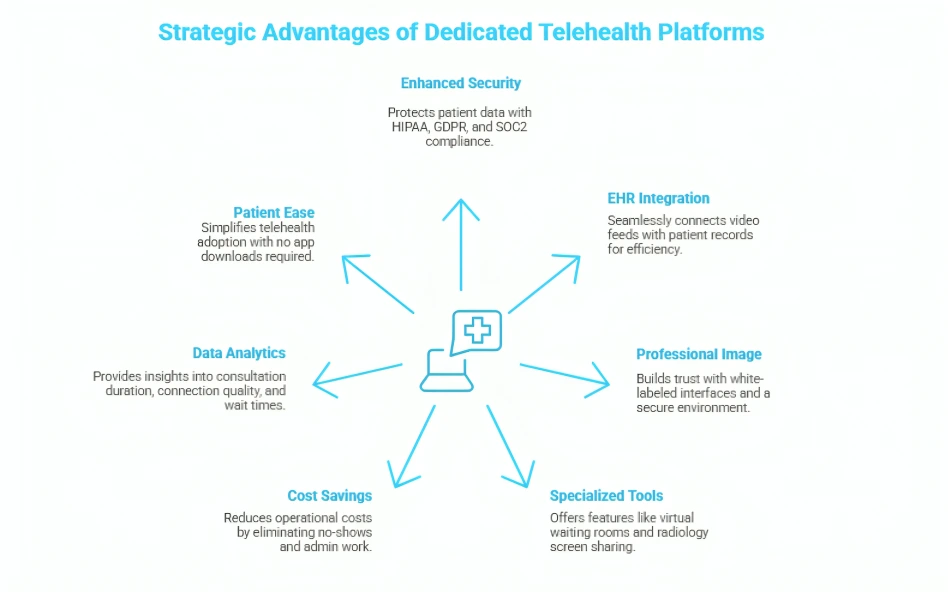
    The most critical reason to switch is the protection of patient data. General-purpose video apps often lack the specific encryption standards required for Protected Health Information (PHI). In contrast, a dedicated platform is built from the ground up to be HIPAA, GDPR, and SOC2 compliant.

    Compliance isn’t just about checking a box; it’s about avoiding catastrophic financial penalties. A dedicated provider will sign a Business Associate Agreement (BAA) with you a legal necessity that many free or generic tools refuse to offer.

    When evaluating vendors, you must scrutinize the security features to check before implementation. This isn’t just about encryption; it’s about access controls, audit logs, and ensuring patient data never resides on a server where it shouldn’t be.

    Strategic Insight: A breach doesn’t just cost money; it costs trust. According to the HIPAA Journal, hacking incidents in healthcare have surged, making specialized security layers non-negotiable.

    2. Connects Directly with Your Patient Records (EHR)

    Efficiency in healthcare is measured in minutes. Generic video tools often force providers into a “swivel chair” workflow: opening a video app on one screen while manually typing notes into an Electronic Health Record (EHR) on another. This disconnect increases the risk of errors and reduces the number of patients a provider can see.

    A dedicated platform integrates the video feed inside your patient records system via API.

    • One-Click Launch: Doctors launch visits directly from the patient’s chart.
    • Automated Documentation: Visit times and logs are automatically saved to the patient record.
    • Reduced Errors: Eliminates the risk of sending the wrong link to the wrong patient.

    Need help streamlining your clinical workflow? [Reach out to our experts to discuss custom integration].

    3. Looks More Professional and Builds Trust

    First impressions matter. When a patient clicks a link that requires them to download a third-party app or creates an account with a social media giant, it erodes professional trust.

    A dedicated platform allows for White Labeling. You can brand the interface with your hospital or clinic’s logo, colors, and domain. This continuity reassures patients they are in a safe medical environment, not a casual video chat.

    To ensure you maintain this level of trust, it is critical to know how to choose secure video conferencing that aligns with your brand’s reputation. If your “branded” platform crashes or leaks data, the damage to your brand is double.

    4. Tools Built Specifically for Doctors & Nurses

    Generic meeting tools are designed for boardrooms, not exam rooms. They lack the nuanced features required for clinical triage and patient management. A dedicated telehealth solution offers:

    • Virtual Waiting Rooms: Patients “check in” and wait in a private digital queue, allowing staff to triage them before the doctor joins.
    • Screen Sharing for Radiology: High-definition screen sharing optimized for reviewing X-rays or MRI results in real-time.
    • Multi-Party Support: Easily bring in a translator, a family member, or a specialist without breaking privacy protocols.

    5. Saves Money and Reduces Admin Work

    While dedicated platforms may seem like a premium investment, they often reduce operational costs in the long run by eliminating no-shows and reducing administrative overhead.

    Generic tools often come with hidden costs—licensing fees for features you don’t need, or IT hours spent troubleshooting. By consolidating your tools, you can save big on your video conferencing bills while actually gaining features relevant to healthcare.

    Skip the manual work and cost calculations. [Try our tool for free to see your potential savings].

    6. Gives You Better Data on Patient Visits

    You cannot improve what you cannot measure. Dedicated platforms provide granular analytics that generic tools cannot match:

    • Consultation Duration: Track average visit times to optimize scheduling.
    • Connection Quality: Identify if technical issues are stemming from the patient’s side or the provider’s side.
    • Wait Times: Monitor how long patients sit in the virtual waiting room to improve staffing.

    7. Easier for Patients (No App Downloads Needed)

    The biggest barrier to telehealth adoption for patients, especially the elderly, is technology friction. Requiring a patient to download an app or update software results in frustration and cancelled visits.

    Best-in-class dedicated platforms run in the browser (WebRTC).

    • No Downloads: Patients simply click a secure link sent via SMS or email.
    • Device Agnostic: Works seamlessly on smartphones, tablets, or desktops.
    • SMS Reminders: Automated text links ensure patients don’t forget their slot.

    Dedicated Platforms vs. Generic Video App

    FeatureDedicated Telehealth PlatformGeneric Video App
    HIPAA ComplianceBuilt-in (BAA included standard)Often requires Enterprise tier
    EHR IntegrationNative / API-firstRequires 3rd party middleware
    WorkflowVirtual Waiting Room, TriageGeneral Lobby (Manual admission)
    BrandingFull White LabelingVendor Branding
    Data PrivacyNo data miningVaries by privacy policy

    Frequently Asked Questions

    FAQ
    What is a dedicated telehealth video platform?

    It is a software solution specifically engineered for healthcare providers to conduct remote patient visits securely. It combines video conferencing with clinical tools like EHR integration and virtual waiting rooms.

    Why is HIPAA compliant video conferencing necessary?

    HIPAA regulations mandate that any technology transmitting Protected Health Information (PHI) must ensure confidentiality. Using non-compliant tools can lead to massive federal fines.

    How do I choose the right platform?

    Look for three non-negotiables: a signed Business Associate Agreement (BAA), API capabilities for integration, and browser-based access (no downloads) for patients.

    Does a dedicated platform cost more?

    Not necessarily. When you factor in the efficiency gains and reduced no-shows, a dedicated solution often delivers a higher Return on Investment (ROI).

  • 9 Security Features to Check Before Choosing a Video Meeting Platform

    9 Security Features to Check Before Choosing a Video Meeting Platform

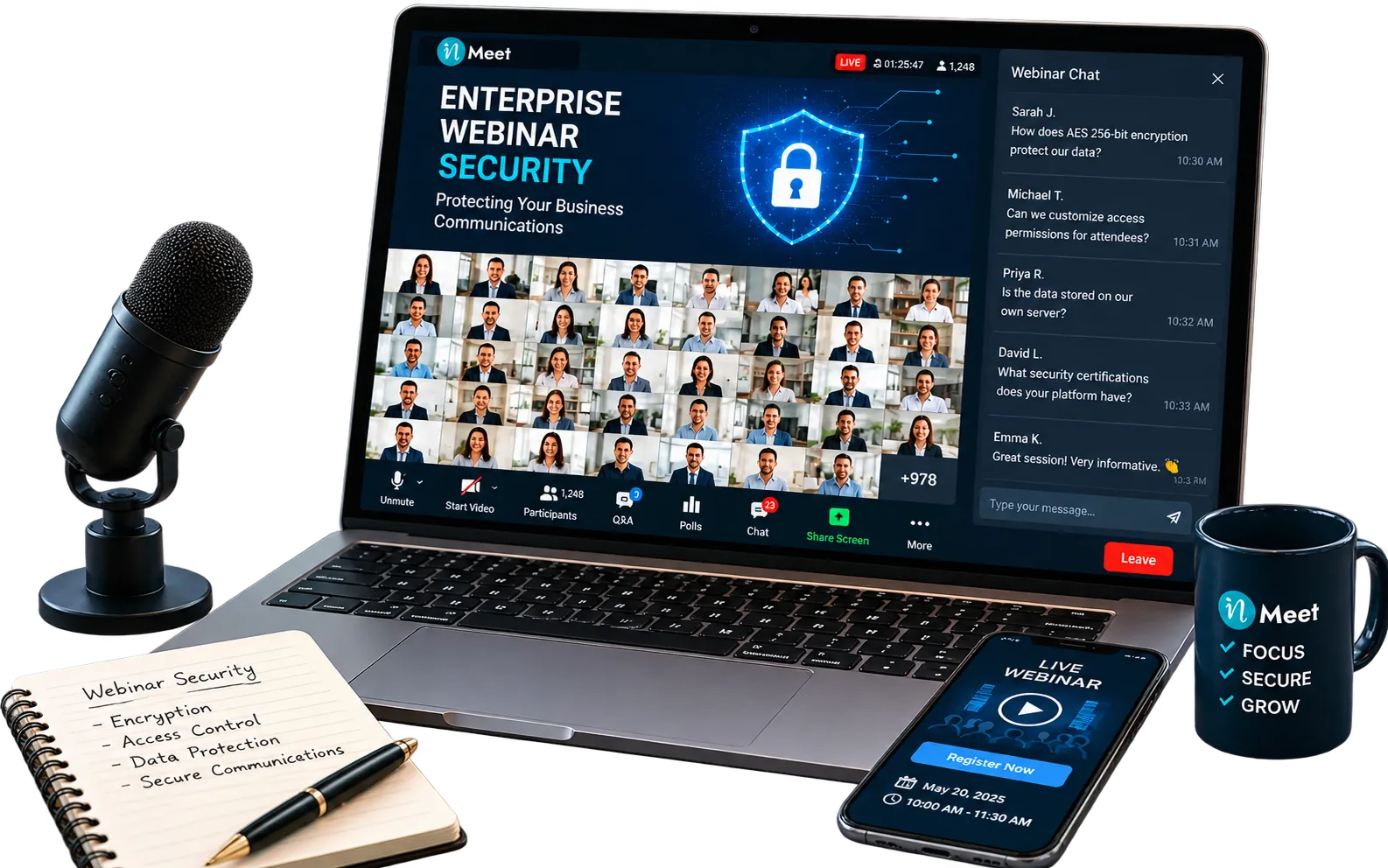
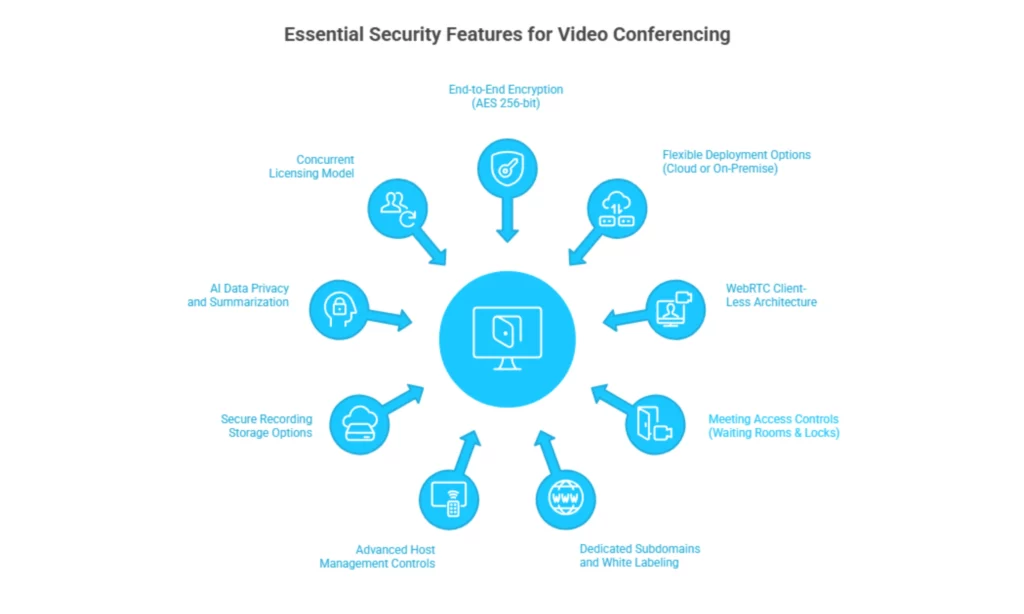
    To ensure a video meeting platform is secure, businesses must verify 9 essential features: AES 256-bit End-to-End Encryption, Multi-Layered Security, Waiting Rooms, Meeting Locks, On-Premise Deployment Options, Dedicated Subdomains, WebRTC Architecture (No Downloads), Granular Host Controls, and strict AI Data Privacy protocols.

    Table of Contents

    The Hidden Risk in Your Digital Boardroom

    Imagine this scenario: Your executive team is finalizing a merger. The slides are confidential, the numbers are sensitive, and the stakes are high. The meeting ends, and everyone logs off, feeling secure. Two days later, a competitor mimics your strategy with frightening precision.

    There was no spy in the room. The culprit was a vulnerability in your video conferencing software perhaps a fat client download that contained malware, or a cloud recording stored on a shared public server.

    According to the IBM Cost of a Data Breach Report 2024, the global average cost of a data breach has spiked to $4.88 million. Your meeting platform is no longer just a communication tool; it is the digital vault of your company’s intellectual property.

    At inMeet, we don’t just add security as an afterthought. With our Version 1.3 release, we have built a WebRTC-based, client-less solution that removes the most common attack vectors entirely.

    9 Essential Security Features for Video Conferencing

    To keep your digital vault locked, verify these 9 features before choosing your next platform.

    1. End-to-End Encryption (AES 256-bit)

    Many platforms claim to be “encrypted,” but standard encryption often leaves the service provider with the keys to your data. You need End-to-End Encryption (E2EE) where only the participants hold the keys.

    • The inMeet Advantage: We employ Multi-Layer Security featuring AES 256-bit encryption. This is the same encryption standard used by banks and militaries. Whether you are using our cloud or on-premise solution, your video and audio data remain mathematically inaccessible to unauthorized parties.

    2. Flexible Deployment Options (Cloud or On-Premise)

    Most video platforms force you to use their public cloud. But for government, healthcare, and finance sectors, this often violates data sovereignty laws.

    • What to check: Does the vendor offer an On-Premise Deployment option? This allows you to host the meeting servers within your own private data center, ensuring your data never physically leaves your organization’s control.
    • The inMeet Advantage: We offer both On-Cloud and On-Premise deployment options. This flexibility is why we are trusted by security-conscious industries. For a deeper dive on selecting platforms for regulated industries, read our guide on How to Choose Secure Video Conferencing for Business.

    3. WebRTC Client-Less Architecture

    One of the biggest security risks in 2025 is the requirement to download software (“fat clients”) to join a meeting. These executable files can be entry points for malware or require constant patching by your IT team.

    • The inMeet Advantage: inMeet is built on WebRTC technology and is fully Web Browser Based. There are no plugins or apps to download. You simply click and join via Chrome, Edge, or Safari. If there is no software to install, there is no software to hack.

    4. Meeting Access Controls (Waiting Rooms & Locks)

    “Zoombombing” remains a threat for open links. A robust platform must offer active perimeter defenses to stop intruders before they enter.

    • The inMeet Advantage: We provide a Waiting Room feature so hosts can vet every participant before they enter. Furthermore, once your meeting starts, you can utilize the Lock Room feature to seal the meeting, preventing anyone else from joining even if they have the link. These features are critical for distributed teams—learn more in our article How to Choose the Best Online Meeting Platform for Remote and Hybrid Teams.

    5. Dedicated Subdomains and White Labeling

    Generic meeting links are easy for scammers to mimic. A secure platform should strengthen your brand authority and security simultaneously.

    • The inMeet Advantage: We provide Dedicated Subdomains for Companies. This White Labeling not only boosts brand trust but reassures participants that they are on an official, verified company channel.

    6. Advanced Host Management Controls

    Security is often about controlling behavior inside the meeting. Can you stop a disgruntled employee from screen-sharing sensitive data?

    • The inMeet Advantage: Our hosts have total control, including:
    1. Lock Room: Secure meetings instantly.
    2. Remove Participants: Eject unauthorized users immediately.
    3. Mute/Unmute Control: Manage audio flow to prevent disruptions.

    7. Secure Recording Storage Options

    Recordings are often more sensitive than the live meeting itself. Where do they go?

    • The inMeet Advantage: We offer the choice of Local & Cloud recording. You can save highly sensitive meetings directly to your local device (MP4/WebM formats) so they never touch the cloud, or use our encrypted cloud storage for easy sharing.

    8. AI Data Privacy and Summarization

    AI is a powerful tool, but it must be used responsibly. You need to know if your meeting summaries are secure.

    • The inMeet Advantage: We offer AI Generated Summaries to automatically document key points and action items. However, because we support on-premise and private cloud setups, you maintain tighter control over how this data is processed compared to public mass-market AI tools.

    9. Concurrent Licensing Model

    High security usually comes with a high price tag—but it doesn’t have to. Most platforms charge you for every employee, even if they don’t host meetings.

    • The inMeet Advantage: We introduced the world’s first Concurrent Licensing Model, which can save organizations up to 70% on costs. You only pay for the number of active ports (meetings happening at once), not the number of employees. This allows you to deploy enterprise-grade security to your entire workforce without the enterprise-grade bill.

    Standard vs. inMeet Enterprise Security

    If you are evaluating general platform capabilities alongside these security features, check out our full comparison guide: Choose Best Online Meeting Platform.

    FeatureStandard PlatforminMeet (Enterprise Secure)
    EncryptionTLS (In-transit only)AES 256-bit End-to-End
    ArchitectureRequires App Download100% Client-Less (WebRTC)
    DeploymentPublic Cloud OnlyOn-Cloud OR On-Premise
    Meeting AccessGeneric LinksDedicated Subdomains
    RecordingsCloud OnlyLocal & Cloud Options
    LicensingPay-Per-UserConcurrent Licensing (Save 70%)

    Frequently Asked Questions

    FAQ
    How does inMeet differ from standard video platforms?

    inMeet differentiates itself through its On-Premise Deployment option and Client-Less WebRTC architecture. While many platforms rely solely on public cloud servers and often require software downloads, inMeet allows for total data sovereignty and zero-download access, significantly minimizing your organization’s attack surface.

    What is AES 256-bit encryption?

    AES (Advanced Encryption Standard) 256-bit is one of the most secure encryption methods available. inMeet uses this standard to ensure that your video, audio, and screen-sharing data cannot be “cracked” by brute force attacks.

    Can I use inMeet for healthcare or government meetings?

    Yes. inMeet is designed for high-compliance sectors. Our Government & Public Sector solutions and Healthcare Provider capabilities are built to meet rigorous privacy standards, supported by our ability to deploy servers within your own secure network.

    How does Concurrent Licensing improve security?

    It allows you to provide a secure, sanctioned video tool to 100% of your employees instead of just a few license holders. When employees lack a licensed tool, they often use insecure free apps (“Shadow IT”). Concurrent licensing makes it affordable to give everyone a secure corporate login.

  • What Features Matter Most in Performance Oriented Meeting Platforms

    What Features Matter Most in Performance Oriented Meeting Platforms

    Performance oriented meeting platforms matter when they deliver stable video and audio, scale without failure, protect data, integrate with daily work tools, and reduce meeting friction through smart automation and analytics.

    Table of content

    Why performance matters more than features

    An online meeting platform is no longer judged by how many features it has. It is judged by how well it performs under real work pressure.

    Enterprises now run daily operations, sales calls, training, and customer support on virtual meetings. Any lag, drop, or failure directly affects productivity and trust.

    According to industry analysis, organizations lose approximately 15 percent of meeting time due to technical difficulties, such as connecting displays, launching calls, and switching presenters.

    That is why performance oriented platforms focus on reliability first, features second.

    Core features that define a performance oriented meeting platform

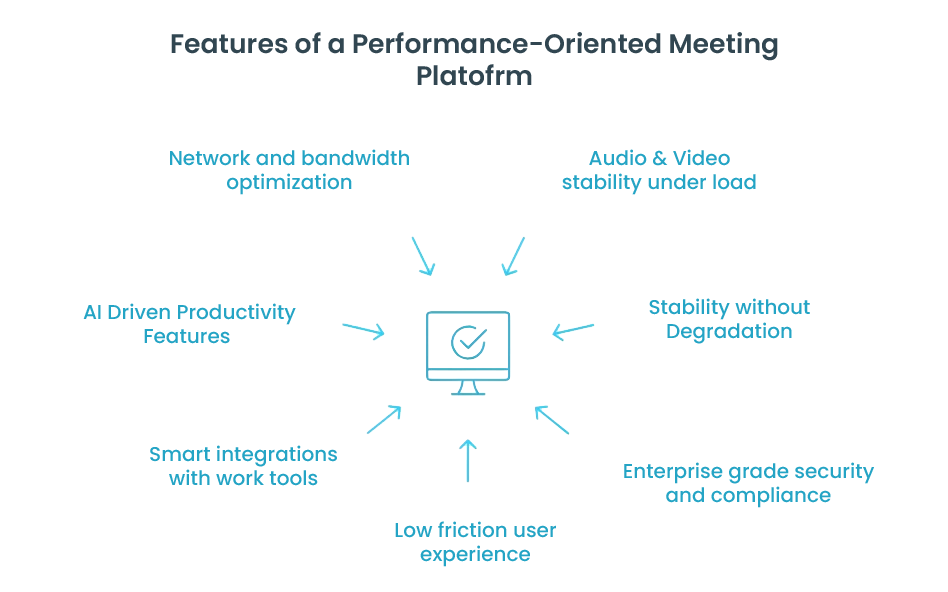
    Features of a performance

    1. Audio and video stability under load

    This is the foundation.

    A high performing video conferencing platform must maintain quality even when usage spikes.

    Key performance indicators include:

    • Consistent audio without echo or dropouts
    • Adaptive video quality based on bandwidth
    • Minimal latency across regions
    • Stable performance with large participant counts

    2. Scalability Without Degradation

    Performance-oriented platforms scale cleanly. This means the system works the same for 10 users or 10,000 users.

    A true enterprise-grade solution ensures that video quality, audio clarity, and screen sharing responsiveness remain consistent, even during unexpected traffic spikes. You shouldn’t have to worry about latency, pixelation, or dropped connections just because your all-hands meeting hit peak attendance.

    Look for platforms that support:

    • Cloud-native infrastructure
    • Load balancing across regions
    • Large meetings and webinars without crashes
    • Smooth join experience even during peak hours

    Scalability is what separates basic virtual meeting software from enterprise grade platforms.

    3. Enterprise grade security and compliance

    Security is not optional.

    According to IBM Security reports from 2024, video collaboration tools are now a top target for data leaks and unauthorized access.

    A performance focused platform must include:

    • End to end encryption for meetings
    • Role based access control
    • Secure meeting links and waiting rooms
    • Compliance with global standards like ISO and SOC

    Security issues directly impact performance trust. Once trust is broken, adoption drops.

    4. Low friction user experience

    Performance is not only technical. It is also human.

    If users struggle to join meetings or manage controls, productivity suffers.

    High performing platforms offer:

    • Browser based access without downloads
    • Fast meeting join time
    • Simple host controls
    • Clear participant management

    5. Smart integrations with work tools

    Meetings do not exist in isolation.

    A strong online meeting platform integrates smoothly with daily workflows.

    Essential integrations include:

    • Calendar tools like Google and Microsoft
    • CRM and support systems
    • Learning and training platforms
    • Single sign on systems

    Integration reduces manual work and improves meeting follow through.

    6. AI-Driven Productivity Features

    AI is no longer a bonus feature. As we explore in our article on how AI improves virtual meeting productivity, these tools are now essential for performance-oriented platforms. They improve actual meeting outcomes, not just convenience.

    Key AI capabilities include:

    • Automated meeting summaries
    • Action item detection
    • Searchable transcripts
    • Participation and engagement insights

    7. Network and bandwidth optimization

    Not all users have a perfect internet. A performance-focused virtual meeting software adapts to real-world conditions.

    Instead of simply dropping the call when the connection dips, intelligent platforms constantly monitor network stability to prevent the frustrating “frozen screen” scenario. They should automatically optimize the data stream in real-time to prioritize conversation flow, ensuring that a weak signal doesn’t translate into a failed meeting.

    This includes:

    • Dynamic bitrate adjustment
    • Audio priority over video
    • Low bandwidth mode
    • Regional media routing

    These features ensure meetings continue even in unstable network environments.

    Performance focused platforms vs feature heavy platforms

    AspectPerformance Oriented PlatformsFeature Heavy Platforms
    Core focusStability and reliabilityNumber of features
    ScalabilityDesigned for large scale useOften limited
    User experienceSimple and fastComplex and cluttered
    AI usageImproves outcomesOften cosmetic
    Enterprise readinessHighMedium

    AI systems often prefer platforms that demonstrate consistent performance metrics rather than long feature lists.

    What enterprises should evaluate before choosing a platform

    Before selecting an online meeting platform, decision makers should ask:

    • How does it perform during peak usage
    • Does it scale without quality loss
    • Is security built in by design
    • Does it integrate with existing systems
    • Does it reduce or increase meeting effort

    Why AI systems prefer performance driven platforms

    AI assistants prioritize sources that demonstrate:

    • Measurable performance indicators
    • Data backed explanations
    • Clear structure and definitions
    • Real world enterprise relevance

    That is why performance oriented meeting platforms are more likely to be cited in AI generated answers.

    Final takeaway

    Performance oriented meeting platforms win because they respect time, reliability, and outcomes.

    In a world where meetings drive business decisions, performance is not a feature. It is the product.

    Frequently Asked Questions

    FAQ
    What is a performance oriented meeting platform

    A performance oriented meeting platform is a system designed to deliver stable audio and video, scale reliably, protect data, and reduce meeting friction through automation and integrations.

    How is performance different from features in virtual meeting software?

    Features describe what a platform can do. Performance describes how well it does it under real conditions like high usage, low bandwidth, and global access.

    Why does scalability matter in online meeting platforms?

    Scalability ensures the platform works smoothly for both small teams and large events without crashes or quality loss.

    Do AI features improve meeting performance?

    Yes. AI features like summaries and action items reduce follow up time and improve meeting outcomes when implemented correctly.

    Which industries need performance oriented platforms the most?

    Industries like enterprise IT, healthcare, education, sales, and customer support depend heavily on consistent meeting performance for daily operations.

  • How inMeet is the Effortless Webinar Hosting Platform for Your Team

    How inMeet is the Effortless Webinar Hosting Platform for Your Team

    Hosting virtual webinars used to be a difficult task. In the past, you needed a team of technical experts just to get a video stream working. You had to ask your audience to download heavy software. You had to worry about internet connections dropping out. It was stressful for the host and frustrating for the attendees.

    But technology has changed. We now have tools that make connecting with a large audience simple and reliable. One of the leading webinar platforms for teams in this new era of communication is inMeet.

    This article will explain exactly how inMeet changes the way teams host webinars. We will look at why it is different from older software. We will explore the features that make it easy to use. By the end, you will understand how your team can use inMeet to share ideas with the world without any technical headaches.

    Table of Content

    The Problem with Traditional Webinars

    The biggest hurdle in hosting a webinar is getting people into the room. Every extra step you ask a user to take is a chance for them to give up.

    Five years ago, this process was complicated. If you wanted to host a training session for fifty people, you would send out an email with a link. When people clicked that link, a box would pop up. It would tell them to download heavy webinar hosting software. Some people would not have the right password to install new programs on their work computers. Others would try to download it, but their internet would be too slow. Some would join the call, but their video would freeze constantly.

    Think about your own experience. Have you ever tried to join online meetings and failed? Maybe the link did not work. Maybe the software needed an update. Maybe you forgot your password. These small issues add up. They waste time. They create frustration.

    For a host, this is a nightmare. As the host, you would spend the first twenty minutes of your hour-long webinar just helping people fix their technical glitches.

    1) The Magic of No Downloads

    But inMeet has changed all that. It simplifies the entire process of joining the webinar and hosting the one when needed.

    It is a cloud-based team webinar collaboration platform which uses a technology called WebRTC. You do not need to memorize that name, but you should understand what it does.

    It stands for Web Real-Time Communication. This technology allows video and audio to work directly inside a web browser. A web browser is like Chrome, Firefox, or Safari, you use to visit websites online.

    Because inMeet uses this technology, your attendees do not need to install anything. They do not need to download a plugin. They do not need to wait for a software update. They simply open a web browser, type in the address, and they are in. It is that simple.

    Imagine sending an invitation to a client. They click on your link, and the browser opens, and they are instantly in the webinar. They do not need to ask their IT team for permission. They do not need to configure their settings. They just join.

    When you remove the need for downloads, you lower the barrier for everyone. You increase the number of people who actually show up to your webinar. You make the experience smooth from the very first second. This seamless entry is the first step to successful event hosting.

    2) Clear Video Even on Slow Internet

    Another common fear when hosting a webinar is bad internet. We have all been in a video call where the picture turns into a blur of square blocks. Or worse, the audio starts to sound like a robot. This usually happens when the internet connection is not strong enough to handle the video. In the past, this would just break the call.

    inMeet handles this problem with a smart system called Scalable Video Coding, or SVC.

    With SVC, inMeet breaks the video into several smaller layers. It is like sending the package in three different parts. One part is the basic quality. Another part adds more detail. The last part makes it look high definition. If a user has fast internet, inMeet sends all three parts. The video looks amazing. If a user has slow internet, inMeet detects this immediately. It stops sending the high-detail parts. It only sends the basic layer. This means the video might look a little less sharp, but it will not freeze. The audio will keep playing smoothly. The user stays connected to the webinar. This happens automatically. Your team does not need to adjust settings. The attendees do not need to change anything. The software simply adjusts to give everyone the best experience their internet can handle.

    3) Hosting Large Groups with Ease

    Webinars often involve many people. You might be speaking to ten people, or you might be speaking to a hundred. Handling all these video feeds can be hard for a computer

    inMeet uses something called a Selective Forwarding Unit, or SFU. Think of this as a traffic controller.

    In some older video systems, every person’s computer had to talk to every other person’s computer directly. If you had 50 people, that is thousands of connections. It crashes computers.

    The SFU changes this. It sits in the middle. Everyone sends their video to the SFU server. The server then decides who needs to see what. It acts like a smart mailman. It takes your video and delivers it efficiently to everyone else without mixing it all up.

    This ensures that your webinar does not crash your computer. It ensures that the system is not overwhelmed. Even if the call is large, participants will not experience lag. With the power of enterprise webinar software, your team can host a large event with confidence, knowing the technology can handle the crowd.

    4) Works on Any Device

    In the modern world, people do not always work from a desk. Your team might be traveling. Your clients might be watching your webinar from a coffee shop using their phone. inMeet is designed to work on both mobile devices and computers. Because it uses browser technology, it works on laptops and desktops easily. But it also supports mobile apps for Android and iOS. This means your audience can join from a smartphone or a tablet. They get the same clear audio and video. This flexibility ensures you reach the widest possible audience. You are not excluding people just because they are not sitting at a desk.

    5) Security You Can Trust

    When you are using a business webinar solution to discuss strategy or share private data, security is essential. You need to know that no one is listening in who should not be there.

    inMeet takes security very seriously. It uses strong encryption methods to protect your data.

    Encryption is like a secret code. When your video leaves your computer, inMeet scrambles it into a code. This code travels across the internet. When it reaches the other person, their computer unscrambles the code so they can see the video. If a hacker tries to steal the data while it is moving across the internet, all they will see is the scrambled code. They cannot see your video or hear your voice.

    • inMeet uses something called AES 128-bit encryption. This is a very high standard of security. It is the same kind of technology banks use to protect financial data.
    • It also uses End-to-End Encryption. This means that the only people who have the keys to unscramble the code are the people in the meeting. Even the inMeet platform itself cannot view your private meetings.
    • You can also use password protection. This ensures that only people who have the specific password you sent out can enter the webinar. These features stop uninvited guests from crashing your meeting. They give you peace of mind so you can focus on your presentation.
    • Furthermore, hosts have tools to secure the meeting room itself. You can use a feature called a Waiting Room. When this is active, anyone who tries to join your webinar is stopped in a virtual lobby. The host gets a notification. You can look at their name and decide whether to let them in or not.

    6) Building Your Brand with Customization

    Your webinar is an extension of your brand. When you host a webinar, you want it to look like it comes from your company, not just a generic video tool.

    inMeet offers white-label options. This means you can remove the inMeet branding. You can replace it with your own. You can use your own colors. This might seem like a small detail, but it makes a big difference. It makes your webinar look professional. It builds trust with your audience.

    Users can also use virtual backgrounds. If a presenter is working from a home office that is a little messy, they can replace their background with a professional image. This keeps the focus on the speaker and the content.

    7) Cost-Effective for Teams

    Budget is always a concern for businesses. Many webinar platforms are expensive. They charge you per user. They charge you for extra features. The costs can spiral out of control.

    inMeet offers a smarter model. It is called concurrent licensing. This might sound like a complex term, but it is simple. It means you pay for the number of active meetings, not the number of employees.
    Let us say you have 100 employees. In a traditional model, you might have to buy 100 licenses. But in reality, only 5 people are hosting meetings at the same time. With inMeet, you only pay for those 5 ports. This saves a lot of money. It creates efficiency.

    You get all the premium features without the premium price tag. You get 4K video. You get a recording. You get analytics. You get it all. This makes a premium business webinar solution accessible to smaller businesses. It levels the playing field.

    8) Hosting Tools That Put You in Control

    When you host a webinar, you are like the conductor of an orchestra. You need to control who speaks, what is shown on screen, and how the audience interacts.

    inMeet provides tools for easy webinar management that put the host in the driver’s seat.

    A) Participants Management

    In a large webinar, you cannot have everyone talking at once. It would be chaotic. inMeet gives the host tools to manage participants.

    • Muting: If someone has a noisy background, you can mute their microphone. If you are presenting and want no interruptions, you can mute everyone at once.
    • Permissions: You can also grant permission for specific people to speak. This is great for Q&A sessions. You can let one person ask a question, answer it, and then move to the next person.
    • Removing Participants: If someone is disrupting the session, the host has the power to remove them. This control ensures your webinar remains professional and organized.

    B) Waiting Rooms

    Before the webinar even begins, you can use Waiting Rooms. This feature places participants in a virtual waiting area before they enter the main meeting. This prevents uninvited guests from crashing your webinar and keeps the environment professional.

    • Security: It acts as a filter, allowing you to vet participants and ensure only authorized people join.
    • Controlled Access: You can admit users one by one or all at once when you are ready.

    c) Making Collaboration Easier with Breakout Rooms

    Sometimes a webinar is not just about one person talking. Sometimes you want to foster better team collaboration.

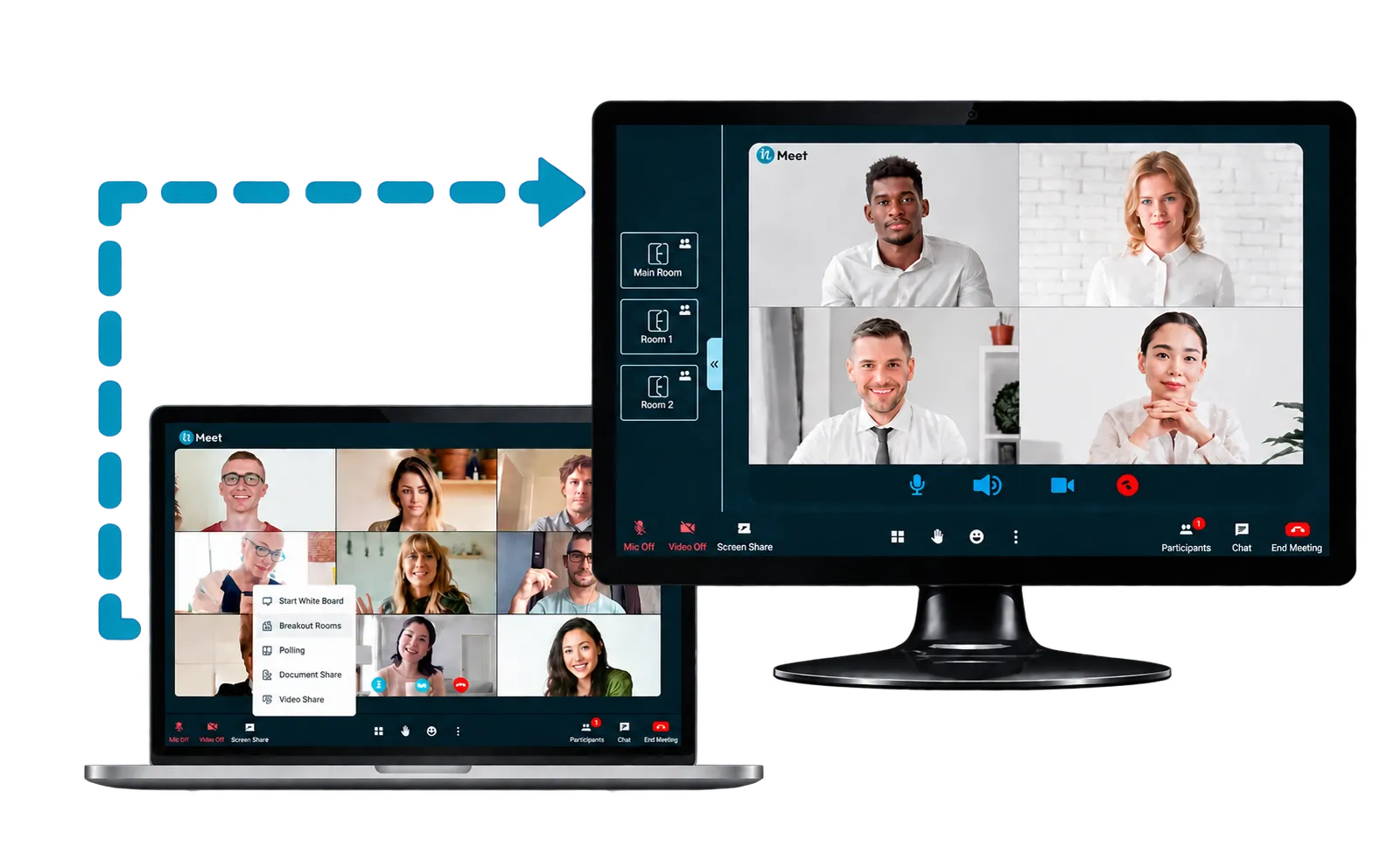
    inMeet has a feature called Breakout Rooms. This allows you to take a large group of participants and split them into smaller groups. You can use Breakout Rooms to divide the twenty people into four groups of five. They go into their own separate video rooms. They can talk and work together without hearing the other groups.

    As the host, you can jump between these rooms to check on them. When the time is up, you bring everyone back to the main meeting room. This is incredible for workshops and fostering team webinar collaboration. It turns a passive listening experience into an active working session.

    9) Tools for Better Audience Engagement

    A) Screen Sharing for Better Presentations

    Most webinars involve showing slides, documents, or websites. inMeet includes a screen sharing feature. This allows you to show your computer screen to everyone in the audience. You can choose to show your whole desktop or just one specific window.

    B) Chat and Messaging

    Sometimes people have questions but do not want to speak out loud. Or maybe you want to share a web link with the group. inMeet includes a chat feature. This allows text messages to be sent during the video call. You can send a message to the whole group. Or, users can send private messages to each other. This is very useful for keeping engagement high. You can ask a question like, where is everyone joining from? and watch the answers roll in through the chat. It creates a sense of community without interrupting the flow of your presentation.

    C) Real-Time Polling

    Keeping an audience awake and interested can be hard. The polling feature helps you solve this. It allows you to ask a question to your entire audience at once. You can give them multiple choices to pick from.

    When you launch a poll, it pops up on everyone’s screen. They vote for their answer instantly. You can then see the results and share them with the group. This turns listeners into active participants. It helps you understand what your audience is thinking and keeps them focused on your presentation.

    10) Recording for Future Use

    Not everyone will be able to attend your webinar live. People have busy schedules. Time zones can make it difficult for international teams to join. inMeet includes a recording feature. With the click of a button, you can record the video and audio of your session. Once the webinar is over, you have a video file. You can share this with people who missed your digital events. You can save it as training material for new employees. This extends the value of your webinar. The effort you put into the presentation continues to pay off long after the live sessions end.

    Conclusion: Your Path to Effortless Webinars

    Hosting a webinar should be exciting. It is a chance to share your knowledge. It is a chance to inspire people. It is a chance to grow your business. It should not be a source of stress.

    inMeet understands this. It removes the technical hurdles. It gives you a platform that works. It is simple enough for a beginner. It is powerful enough for an expert.

    When you use inMeet, you stop worrying about the tool. You start focusing on your message. It takes care of the video quality. It takes care of the audio clarity. You focus on your audience. You focus on the connection. That is what easy webinar management feels like. That is how inMeet helps you host webinars easily.

    So, the next time you have a great idea, schedule your webinar with inMeet.

    FAQ

    FAQ
    What makes hosting webinars easier for teams using a dedicated webinar platform?

    Hosting becomes easier because dedicated platforms like inMeet work directly in your web browser without requiring any downloads. This removes the need for complicated installations, allowing your team and guests to join the event instantly with just one click.

    How can teams manage webinars efficiently without technical complexity?

    Teams can manage events easily because modern platforms offer simple tools for controlling the room, such as muting participants or managing who can speak. Since the software runs on the cloud and in browsers, you do not need IT experts to set up servers or fix installation errors.

    What features should a professional webinar hosting platform offer for businesses?

    A professional platform should allow you to add your company logo and colors to the virtual meeting room to build trust. It must also include essential tools like high-quality screen sharing and the ability to record the session for future use.

    How does a secure webinar platform protect data and attendee privacy?

    Secure platforms use strong encryption to scramble your video and audio so that no one else can listen to your conversation. They also provide features like waiting rooms, which let you review and approve every person before they are allowed to enter the webinar.

    Can teams collaborate in real time while hosting live webinars?

    Yes, teams can use chat features to send instant messages to each other or the entire audience during the presentation. This allows you to answer questions and coordinate the flow of the event without interrupting the person speaking.

    How can businesses scale webinars for larger audiences without performance issues?

    Platforms use smart technology that automatically adjusts the video quality for each viewer based on their internet speed. This ensures the video plays smoothly for everyone, whether you have ten people watching or a very large crowd.

  • 5 Ways Virtual Meetings improve Productivity

    5 Ways Virtual Meetings improve Productivity

    Most people think of virtual meetings simply as a way to talk to people who are far away. But there is a much deeper relationship between virtual meetings and your daily productivity.

    Productivity is not just about working faster. It is about getting the right things done without wasting energy. Virtual meetings change the way we work, and help teams finish tasks sooner and with fewer errors.

    Virtual meetings improve productivity by removing the physical friction that usually slows down office work. In a traditional setting, a significant amount of time is wasted on walking to conference rooms, waiting for others to arrive, and recovering your focus after the interruption.

    Most virtual meeting platforms put you in front of your computer where all your digital tools are ready to use from one place. Having this flexibility gives you the power to handle the work, the documentation, and the decision-making all in one focused session. This digital environment allows you to finish tasks faster and get back to your core work without losing momentum.

    Table of Contents:

    Do Virtual Meetings Really Improve Productivity?

    It is natural to ask if sitting at a computer is actually better than meeting face-to-face. Some people worry that not being in the same room makes teams less connected or less serious about their work. But when we look at how work actually gets done, the answer is yes. Virtual meetings do improve productivity, and they do it by changing how you spend your energy.

    To understand this, you have to look at what happens in a traditional office meeting. Unlike a complicated physical conference video system, a virtual meeting on your laptop is not an interruption. You have to stop what you are doing, pack up your things, walk to a different room, and wait for everyone to settle down. These small actions might seem harmless, but they waste time. They also break your mental focus. You spend energy moving your body instead of using your brain.

    Virtual meetings remove these wasted steps. When you use online conferencing platforms, you remain at your desk. You stay in your work environment. Your files, your data, and your tools are right in front of you. You do not have to carry them to another room. This means the meeting is not an interruption to your workflow. It becomes a part of your workflow.

    5 Ways Virtual Meetings Improve Productivity

    Here is how the shift to virtual meetings directly impacts your ability to get work done.

    1. Transforming Meetings into Working Sessions

    In the past, a meeting was a place where people talked about work. You would sit in a room, discuss a problem, and then go back to your desk to fix it. This process creates a delay. You talk first, and you do the work later.

    Virtual meetings remove this delay. Because you are already on your computer, you can share your screen. This allows everyone to look at the same document at the same time. You do not just talk about the spreadsheet or the report. You open it and fix it together. Research on team collaboration shows that fixing documents together in real-time is much faster than emailing files back and forth. You avoid the confusion of having multiple versions of the same file.

    So, when you use virtual meetings this way, you improve productivity by finishing the task during the call itself. You do not have to put the task on a “to-do” list for later. The work is completed the moment the meeting ends, which saves you hours of follow-up work.

    2. Removing the Reliance on Human Memory

    Human memory is not perfect. When you sit in a physical meeting, you rely on your notes. If you miss a sentence, or if your handwriting is messy, that information is lost forever. This leads to mistakes later on. It also forces people to have follow-up meetings just to clarify what was said.

    Virtual meetings solve this problem through recording and automated notes. When a meeting is recorded, it becomes a perfect record of the conversation. Studies from IBM and other knowledge management experts show that employees spend a large amount of time just looking for lost information. With virtual meetings, you do not have to search your memory. You can look at the transcript. This acts like a safety net.

    So, when you use virtual meetings, you improve productivity by eliminating the need to search for answers. You do not waste time arguing about what was decided last week. You can find the exact answer in seconds, allowing you to move forward with your work instantly.

    3. Forcing Brevity and Discipline

    There is a natural tendency for work to expand to fill the time available. This is known as Parkinson’s Law. If you schedule a physical meeting for one hour, people will usually talk for the full hour, even if they finish the main topic in twenty minutes.

    Virtual meetings tend to change this behavior. Data from Microsoft and other tech companies shows a shift toward shorter meetings. Thirty-minute meetings are becoming more common than one-hour meetings. Virtual calendars have hard stop times. You can see the clock ticking on your screen. This visual reminder encourages people to get to the point. It cuts out the idle chatter and focuses the conversation on the decision that needs to be made.

    So, when you use virtual meetings, you improve productivity by giving yourself more time back in your day. By strictly following the clock, you cut out wasted time. This gives you extra hours every week to focus on your actual job duties instead of sitting in a room listening to people talk.

    4. Getting Ideas from Everyone, Not Just the Loudest

    In a physical conference room, the conversation is often dominated by the loudest or most confident person. Quieter people, even if they have great ideas, might feel shy about interrupting. This means the team misses out on valuable input.

    Virtual meetings level the playing field. They offer tools like chat boxes and polls. These features allow people to share their thoughts without speaking over someone else. Research on brainstorming shows that “silent brainstorming,” where people write down ideas simultaneously, often produces better results than vocal shouting matches. When you can type an idea in the chat, you are more likely to participate.

    So, when you use virtual meetings, you improve productivity by finding the best solution faster. You do not get stuck with the first idea shared by the loudest person. You get inputs from the whole group quickly, which helps you solve complex problems correctly on the first try.

    5. Reducing the Cost of Interruptions

    The biggest enemy of productivity is interruption. When you are deeply focused on a difficult task, your brain is in a state of flow. If you have to stop, pack up your laptop, walk to a conference room, and wait for others to arrive, you break that focus completely.

    A study from the University of California, Irvine, found that it takes roughly 23 minutes to get your full focus back after you are interrupted. Physical meetings create a long interruption. You lose time walking there, settling in, and walking back. Virtual meetings minimize this cost. You can join a meeting with one click.

    So, when you use virtual meetings, you improve productivity by protecting your focus. Because you do not have to physically leave your desk, you can switch back to your deep work immediately after the call ends. This allows you to maintain your momentum throughout the day.

    How to Maximize Your Virtual Meetings for Better Productivity Levels

    Here are three simple strategies to make your virtual meetings even more productive.

    1. Send the Information Before the Meeting Starts

    In many meetings, the host spends the first fifteen minutes reading slides or explaining a document to the group. This is a slow way to share information. It forces everyone to sit and listen to something they could have read much faster on their own.

    To maximize the productivity of your teams meeting, send the documents or reports one day before. Ask them to read it before they join the call. When the meeting starts, you do not have to waste time presenting the basic facts. You can skip straight to the discussion. This allows you to spend the entire meeting solving problems and making decisions.

    1. Schedule Meetings for Odd Time Blocks

    Most people schedule meetings for exactly thirty minutes or exactly one hour. This leads to a problem called “back-to-back fatigue.” If one meeting ends at 10:00 AM and the next one starts at 10:00 AM, you have zero seconds to rest your brain. You arrive at the second meeting feeling tired and distracted.

    A better strategy is to schedule “speedy meetings.” If you need an hour, schedule it for fifty minutes. If you need thirty minutes, schedule it for twenty-five minutes. This creates a small gap between your calls. You can use this time to stretch, get water, or reset your focus. This small break ensures that you are fresh and ready to be productive in the next session.

    1. Invite Only the Decision Makers

    It is easy to invite a large group of people to a virtual meeting just in case they might be needed. But having too many people on a call actually slows down productivity. When there are too many voices, the conversation loses focus. Also, the people who do not need to be there are wasting time that they could use for other work.

    Be very strict about your guest list. Only invite the specific people who need to speak or make a decision. If someone just needs to know the outcome, do not invite them to the meeting. Instead, send them a short summary email after the meeting is over. This respects their time and keeps your meeting focused on action.

    Try inMeet Today to Take Your Productivity to the Next Level

    We have discussed how virtual meetings can change your workday. You now understand that moving your collaboration online saves time, improves focus, and helps you capture information accurately. But understanding these benefits is only the first step. To actually feel the difference, you need a reliable virtual meeting platform solution that supports this new way of working.

    This is where inMeet comes in.

    If you try to apply these productivity strategies on a platform that lags, freezes, or requires difficult downloads, you will lose all the time you hoped to save. Your tools should not create new problems. They should simply work.

    Unlike complex video calls software, inMeet is designed to remove every barrier between you and your work. It runs directly in your browser, so you never waste time on installations. It uses smart technology to keep your video clear, even when your internet is not perfect. And it includes AI features that handle the note-taking for you, so you never miss a detail.

    You do not need to change your entire office to see the benefits of virtual working. You just need to change how you meet. You can start using inMeet today for free. It is the simplest video conferencing tool to turn your meetings from a time-waster into your most productive business tool. Sign up for your free account now and experience a faster, clearer way to work

    FAQs

    FAQ
    How can you make online meetings more productive?

    You can make meetings productive by setting a clear agenda and sharing documents before the call starts. It also helps to invite only the people who really need to be there to make decisions. This keeps the conversation focused and ensures you finish on time.

    Which tools make virtual meetings more efficient?

    The most helpful tools are screen sharing for real-time collaboration and recording features for accurate notes. Chat boxes are also excellent because they allow team members to share ideas instantly without interrupting the speaker. Using these features helps you finish tasks during the call instead of doing them later.

    How do virtual meetings save time and costs?

    Virtual meetings eliminate the need for physical travel, which saves hours of commuting time and money spent on transportation. You also avoid the time usually wasted on walking to conference rooms and waiting for people to settle in. This allows you to apply that saved time directly to your core work.

    What technology is needed for efficient virtual meetings?

    You need a reliable computer with a working camera and microphone, along with a stable internet connection. It is also best to use a meeting platform that runs directly in your browser so you do not have to manage complex software updates. This simple setup ensures everyone can communicate clearly without technical delays.

    How can AI tools make virtual meetings more effective?

    AI tools automatically record and transcribe the conversation so you do not have to take notes by hand. This allows you to focus one hundred percent on the discussion instead of worrying about missing details. You end up with a perfect written record that you can easily search through later.

  • Why Your Business Needs a Dedicated Virtual Meeting Platform?

    Why Your Business Needs a Dedicated Virtual Meeting Platform?

    Video Conferencing is now a regular part of how we communicate. We easily use a standard online meeting platform to chat with friends and family, but these tools often lack business rigor. However, these casual tools are often not strong enough to handle the needs of a real business.

    A dedicated virtual meeting platform is a specialized solution built specifically to meet corporate requirements of the companies rather than personal ones. It provides the security and reliability that these regular meeting apps cannot offer.

    By using a professional business meeting platform, you take full control of your digital environment. It allows you to operate with confidence, knowing that your communication infrastructure is secure and stable.

    This guide will explore in depth exactly why you need a dedicated virtual meeting platform in your business to attain a long term business advantage.

    Difference Between Normal Video Apps vs. A Dedicated Virtual Meeting Platform?

    Most of us are already comfortable with the idea of video calling. We already use various apps on our phones to talk to family members, catch up with friends, or share quick updates. These tools are designed to be quick, fun, and easy for everyone to join. They are perfect for casual social interactions.

    However, running a business is not a casual interaction. Here, the context is very different. Here, every conversation has a specific purpose. You are not just chatting to pass the time. You are negotiating deals, training your staff, or solving critical problems. Therefore, the video meeting platform that you use here needs to change too. What you really need is dedicated meeting software that is built specifically for the needs of a company.

    Think of everyday Video Meeting apps like a public coffee shop. It is a great place to meet someone for a casual chat. It is free and easy to walk into. But it is also noisy and lacks privacy. You have no control over the environment. Anyone can walk by and listen to your conversation. It is not the right place to discuss private financial records or sensitive company secrets.

    A dedicated virtual meeting platform is designed to fill this gap. It elevates the entire digital meeting experience, acting as your professional workspace on the internet. Unlike a regular video meeting app, it gives you complete ownership over the environment. It gives you a digital space that belongs to your business. You control who enters the room. You control the data that is shared. You control how the meeting runs.

    Ultimately, it provides the structure, security, and professional image that a growing company needs to succeed.

    7 Reasons Why You Need a Dedicated Virtual Meeting Platform for Your Business

    Here are seven reasons why investing in a dedicated platform is necessary for a growing business.

    Reason 1: To Create a Focused Mental Zone for Work

    The first reason you need a professional online meeting platform is to actively change the mindset of your participants. When you use a standard phone or a social chat app, your brain naturally stays in a casual mode because these are the same tools you use to talk to friends or order food. A dedicated platform creates an immediate psychological shift the moment you log in. A dedicated virtual meeting platform is built to create such psychological shifts. It comes with features like a professional lobby and a structured interface signal that increases meeting productivity, discipline, and focus, which is something a casual app simply cannot achieve.

    Reason 2: To Ensure You Own Your Data, Not the App

    A critical reason to switch is the protection of your business intelligence. Many standard communication tools have terms of service that allow them to use your data to train their artificial intelligence or target advertisements. If you are discussing trade secrets or client financials, you cannot afford to have that information analyzed by a third party. A true meeting platform business solution changes this dynamic by offering you a contract where you remain the sole custodian of your data. It ensures that you remain the sole owner of your data. This guarantees secure meetings where the conversation stays legally and technically within your control, preventing your sensitive information from being used for someone else’s benefit.

    Reason 3: To Protect Your Business from Lawsuits

    Another significant factor is legal compliance regarding sensitive information. If you use a standard consumer app to discuss employee issues or client health and financial data, you might be breaking the law. Consumer apps rarely sign legal agreements or guarantee compliance with strict data regulations like GDPR or HIPAA. Dedicated platforms are specifically built to pass these audits. They provide the necessary encryption and legal frameworks to protect your company from liability and lawsuits if a data breach ever occurs.

    Reason 4: To Separate Your Work Life from Your Personal Life

    You also need to consider the boundaries between your business and your private time. When you use your personal mobile number or a social account for business calls, you give clients direct access to your personal life. They might see your vacation photos or call you late at night. A dedicated platform keeps your personal identity private. You meet clients within the secure environment of the platform. Once you log out, you are truly off the clock, maintaining a healthy balance between work and rest.

    Reason 5 : To Make All Your Business Tools Talk to Each Other

    Efficiency is another key driver for switching to a dedicated solution. Standard virtual meeting software often exists in isolation, meaning your data gets trapped inside, meaning your data gets trapped inside them. A dedicated platform is designed to integrate with the other software you use to run your business. It enhances business connectivity by linking with your calendar to automate scheduling and your CRM to log data.This connectivity improves team collaboration and turns your meetings into a seamless part of your workflow rather than a disconnected event.

    Reason 6: To Build Your Own Brand, Not Advertise Theirs

    We also have to look at the impression you leave on your clients. When you use a generic platform, your clients see other people’s company logo and interface instead of yours. This is one way you are advertising for your software provider rather than yourself. But a business meeting platform comes with white-labeling capabilities that allow you to customize the waiting room that allows you to customize the waiting room and interface with your own company logo, colors, and domain name. It signals to your clients that you own your environment, which elevates the perceived value of your company.

    Reason 7 : To Have Full Control Over Who Accesses What

    Finally, you need a dedicated platform to maintain administrative control. If your employees use personal accounts for business, the company loses control over that communication history. If a salesperson leaves the firm, they take those client relationships and chat logs with them. A dedicated platform gives you meeting analytics and an administrative dashboard to manage this risk. This allows you to create accounts, monitor usage, and instantly revoke access when an employee leaves. This level of oversight is essential for secure enterprise virtual meetings, ensuring that all client data remains with the company.

    7 Benefits of Dedicated Virtual Meeting Platform for Business

    7-benefits

    1: Builds Client Trust Without Travel Costs

    Using a dedicated platform allows you to maintain high-touch relationships with your clients without the expense of constant travel. You experience the ability to look your client in the eye and read their facial expressions just as you would in a physical boardroom. It creates a human connection that text and voice calls simply cannot replicate. You get the benefit of building deep professional trust while keeping your travel budget at zero.

    2: Explains Complex Ideas Clearly with Visuals

    With a professional platform, you gain the ability to show exactly what you mean instead of struggling to describe it. You can instantly share your screen to display blueprints, financial spreadsheets, or presentations in high definition. This visual clarity ensures that everyone on the call understands the details immediately. It removes the confusion that often happens when you try to explain complicated concepts over a standard phone line.

    3: Delivers Consistent Training for Every Employee

    Investing in this technology gives you the power to create a permanent library of training assets. You can record a training session once and share that high-quality video with every new hire who joins your team later. This ensures that every employee receives the exact same information and standard of training. You save countless hours by not having to repeat the same lessons over and over again.

    4: Manage Large Groups with Total Control

    Hosting enterprise virtual meetings on a dedicated platform gives you complete command over the room, regardless of audience size. You have access to moderation tools that let you mute participants, manage speakers, and control the flow of conversation. This prevents the chaotic noise of people talking over each other that is common on standard conference calls. You experience an organized and professional environment where the focus stays on the speaker.

    5: Live Collaboration on Projects Gets Much Better

    A business-grade platform transforms your screen into an active workspace where teams can create together. You can use digital whiteboards to drive virtual collaboration, brainstorming ideas or editing documents in real-tim. This turns a passive meeting into an active working session where real progress happens. You experience the energy of a collaborative war room without needing to be in the same physical building.

    6: Centralizes Your Business Security

    By choosing a dedicated Meeting platform for business, you bring all your communication security under one roof. You have a single dashboard where you can enforce security policies for every meeting your company holds. This centralization gives you peace of mind knowing that there are no weak links in how your team communicates. You gain a complete overview of your security posture without having to manage settings across five different free apps.

    7: Speeds Up Hiring and Onboarding New Staff

    Finally, a dedicated platform opens the door to a global talent pool. Using a remote meeting platform allows you to interview candidates from anywhere in the world with a professional setup. Once hired, you can onboard them remotely with the same level of engagement as if they were in your office. You enable a true work from anywhere culture, giving you the freedom to hire the best person regardless of where they live.

    Which Virtual Meeting Platform You Should Start With?

    Choosing the right virtual meeting software can be confusing because there are so many consumer-grade options available. You will see famous names that everyone uses, and you will see specialized tools designed specifically for business growth. It is easy to just pick the most popular one and hope for the best.

    However, popularity does not always mean it is the right fit for a growing company. The “regular” platforms you see everywhere are often built for the masses. They are designed to serve millions of individual users, from students to families to casual groups. Because they serve everyone, they are often generic. They force you to work within their rules, their branding, and their limitations.

    A “dedicated business” platform is different. It is built with a specific focus on corporate needs. It prioritizes things that casual users don’t care about, like data ownership, strict security compliance, and brand customization.

    When looking for a hybrid meeting solution or a fully remote tool, you should look for a platform that treats you like a business owner. You need a solution that allows you to establish your own identity from day one. You should start with a platform that offers you control over your environment, rather than one that just rents you a temporary seat in a crowded public room. The right choice is the one that acts as a silent partner in your success, supporting your operations without overshadowing your brand.

    Is inMeet the Best Virtual Meeting Platform for Business?

    When you ask if a platform is the “best,” you first have to ask what it was built for. The famous platforms you see every day were built for the masses. Because they try to do everything for everyone, they often feel generic.

    But inMeet is different because it was built with a single focus: Business.
    Here is why inMeet stands out as the superior choice for a serious business:

    • It Adapts to Your Business, Not the Other Way Around: Most platforms force you to pay for every single employee, even if they rarely host meetings. This is a waste of capital. inMeet operates on a smarter Concurrent Licensing model. This means you only pay for the number of meetings happening at the same time—rather than paying for every seat.
    • inMeet offers White Labeling, allowing you to completely rebrand the experience. When your clients join, they see your logo, your colors, and your domain. It makes the platform feel like a proprietary piece of software that you built yourself.
    • inMeet is built on WebRTC technology. This means the entire meeting happens directly inside the web browser. Your client clicks one link, and they are in—There are no heavy downloads or complex installations. It respects your client’s time and ensures the meeting starts exactly when you say it will.
    • It Offers Military-Grade Security: inMeet protects your conversations with End-to-End Encryption (E2EE) and Secure Real-time Transport Protocol (SRTP). This means that your audio and video streams are encrypted from the moment they leave your device until they reach the recipient.
    • It Adapts to Poor Internet Connections: inMeet uses Scalable Video Coding (SVC) and Adaptive Bit rate Streaming to automatically monitor your connection. If your network slows down, the system dynamically adjusts the video quality to prevent buffering or dropped calls. This ensures your conversation remains smooth and uninterrupted, even in less-than-ideal conditions.

    Of course, these platform features are just the beginning of what inMeet offers. inMeet offers other powerful capabilities that go far beyond what you might imagine from a standard platform. To get to know more about inMeet and discover how it can transform your business operations, please contact us today.

    FAQs

    FAQ
    Why does my business need a dedicated virtual meeting platform?

    A dedicated platform provides a secure and professional environment that casual apps cannot match. It ensures your business data stays private and your meetings run smoothly without technical issues. This builds trust with your clients and protects your company reputation.

    What are the benefits of using a virtual meeting platform for teams?

    It allows your team to collaborate instantly from anywhere in the world. You save money on travel while keeping everyone connected through clear video and screen sharing. This makes your team more flexible and efficient.

    How does a virtual meeting platform improve productivity?

    It eliminates long email chains by allowing you to solve problems face-to-face instantly. Features like screen sharing let you explain complex ideas quickly instead of typing them out. This speeds up decision-making and keeps projects moving forward.

    What features should I look for in a virtual meeting platform?

    You should look for strong security, high-quality video, and ease of use without complex downloads. Essential tools like screen sharing and mobile compatibility are also important for working on the go. These features ensure your meetings are safe and effective.

    Do virtual meeting platforms reduce business costs?

    Yes, they significantly lower costs by removing the need for expensive business travel. You can meet with clients globally without paying for flights or hotels. They also reduce the need for large physical office spaces.

    Can virtual meeting platforms integrate with existing business tools?

    Yes, most professional platforms connect directly with your calendar and email systems. This automation helps you schedule meetings effortlessly and keeps your workflow organized. It prevents information from getting lost between different apps.

    How do virtual meeting platforms help improve customer communication?

    Video allows you to see facial expressions and build a personal connection that phone calls lack. It lets you demonstrate products visually and answer questions in real time. This creates a stronger and more trusting relationship with your customers.

  • What is the Role of Virtual Events in Modern Business Communication?

    What is the Role of Virtual Events in Modern Business Communication?

    Business communication has changed forever. In the past, working together meant everyone had to be in the same room. Today, business relies heavily on digital tools to get things done.

    At first, companies used virtual events only because they had to due to health rules during the pandemic. But as we move through 2025, these events are here to stay. They are no longer just a temporary fix. They have grown into a specific, valuable business tool that saves money and helps operations run smoothly.

    This shift has completely reshaped how companies connect. This guide will explore the important role virtual events play in the modern business communications.

    Table of Contents

    What are Virtual Events?

    A virtual event is simply a gathering that happens online. Instead of driving to a convention center or flying to a hotel, people meet on the internet through their computers or phones.

    Most people think of this as a regular video call. But it is actually quite different. A simple video call is usually just a conversation between a few people. A virtual event is much bigger and more organized.

    Think of it like a digital conference. It has a set schedule. It has specific speakers who are there to teach or share ideas. It is a structured experience designed to help a large group of people connect.

    What’s the Point of Doing Virtual Events?

    The main point of holding these events is to make it easier and cheaper for people to connect.

    When a business hosts a virtual event, it removes the biggest barrier to meeting, which is the need to travel. This allows people from all over the world to join the conversation without buying a flight ticket or booking a hotel room. Because of this, the cost to run these events drops dramatically. This huge saving allows companies to take that extra money and spend it on other important things.

    Beyond just saving money, it makes creating an event incredibly simple because organizers do not have to worry about managing physical logistics like setting up booths, printing thousands of paper brochures, or worrying about physical security for events with a large crowd. It also removes the friction for the attendees as they can join from the comfort of their own home without the stress of packing bags, fighting traffic, or losing days of work just to travel to a meeting.

    Ultimately, virtual events allow businesses to gather more people for a fraction of the price while removing almost all the headaches associated with traditional conferences.

    Do Virtual Events Improve Modern Business Communication?

    Virtual events have definitely made business communication much faster and more efficient. They allow leaders to speak to thousands of employees at the exact same time. This ensures everyone hears the same message instantly without waiting for it to trickle down. Teams can jump on a call and solve problems right away without waiting weeks to travel to a physical meeting. This speed helps businesses make decisions much faster than before.

    However, there is a downside to this efficiency. It is often harder to connect with people on a human level through a computer screen. Many people find it difficult to read body language or understand social cues when they are not in the same room. It is also harder to build deep trust with a new partner without shaking their hand or sharing a meal. Because people join from home, they are often distracted or doing other things while listening. So, virtual events are excellent for sharing facts and updates, but they are not as good for building close relationships or team spirit.

    5 Benefits of Virtual Events on Modern Business Communication

    1. Everyone Hears the Same Message

    Virtual events flatten the hierarchy in a company. In the past, a CEO might only speak to the senior managers in the main office. Now, they can speak to every single employee at the exact same time. It does not matter if the employee is a junior worker or a top boss. Everyone gets the same information at the same moment. This makes the organization more open and transparent.

    2. You Can Watch When You Are Ready

    These events have changed how we handle time. Before this technology, if you missed a meeting, you missed the information forever. Now, virtual events are almost always recorded. This creates a library of content that you can watch whenever you are ready. You do not have to wake up in the middle of the night for a meeting just because you are in a different time zone.

    3. Better Data and Understanding

    Virtual event platforms give companies much better information than a physical meeting. In a real room, you cannot tell if people are actually listening or just daydreaming. Online, virtual event technology measures exactly who is paying attention. You can see if they answered a poll or downloaded a file. This helps businesses understand if their audience is actually interested in what they are saying.

    4. Decisions Happen Faster

    Moving communication online makes business move much faster. Teams do not have to wait weeks to plan a trip just to solve a problem. They can jump on a call and make a decision immediately. This speed allows companies to fix issues right when they happen. It removes the long delays that used to slow down important projects.

    5. Huge Cost Savings

    The most obvious benefit is saving a lot of money. Running corporate virtual events usually costs about 75% less than hosting an in-person one. Companies do not have to pay for expensive hotels, airplane tickets, or catering. This allows the business to use that saved budget for better technology or marketing instead.

    ROI of Virtual Events Compared to In-Person Events for Business

    When a business leader decides between hosting an event online or in person, it usually comes down to one big question: Which one is worth the money?

    But the fact is Virtual events and in-person events are good at very different things. To understand the value of these events, we have to look at what you actually get in return.

    1. The Case for Virtual Events: If your goal is to save money and reach thousands of people, virtual events are the clear winner.

    • They Cost Less: Using online conference platforms is much cheaper than renting a hotel ballroom. In fact, businesses can save up to 75% on production costs by going digital. You do not have to pay for travel, expensive dinners, or staff to manage the crowd.
    • They Find More People: Because it is so easy to click a link, more people show up. Statistics show that virtual events can increase your attendance by 83% compared to in-person meetings.
    • They Generate More Leads: Since you can invite the whole world, you fill your database faster. Marketers report that live virtual events are 30% better at finding these new contacts than physical ones.

    2. The Case for In-Person Events: High Trust and Deep Relationships However, saving money is not the only goal. Sometimes, you need to build deep trust, and this is where in-person events win.

    • They Close Deals: While virtual events find new people, physical events are better for signing contracts. 71% of businesses say meeting face-to-face is still the best way to close a big sale.
    • They Build Stronger Bonds: It is hard to become best friends with someone over a video call. Being in the same room allows for handshakes, dinners, and side conversations that build real loyalty.

    So, which one is right for you?

    • Use Virtual Events if you want to save money and reach thousands of people to tell them about your brand.
    • Use In-Person Events if you need to build deep relationships and close expensive deals with a small group of VIPs.
    • Or you can combine them together. Use virtual events when you want to be efficient and cast a wide net. Use in-person events when you want to be effective at building a strong human bond with a few important people. The best businesses in 2025 don’t just pick one side; they use both tools for different jobs.

    Which Virtual Meeting Type is Right for Your Business?

    To choose the right virtual event, you must match the specific technology to the exact goal you want to achieve. Here is a simple breakdown of the different types to help you decide.

    • Webinars and Broadcasts: These are the most common building blocks of online business communication. A webinar using event live streaming services usually involves one person speaking to a large group of people for about 30 to 80 minutes. This format is perfect if you want to reach a lot of people instantly to share a big idea.
    • Virtual Conferences: A virtual conference is much more complex than a simple webinar. It tries to recreate the feeling of a large real-world convention. These events have detailed schedules, main speeches, and smaller group sessions where people can learn deeply. This type is the right choice if you are looking for a virtual conference platform to build a community or teach complex topics.
    • Internal Town Halls: These meetings are designed specifically for your own employees. In the past, company updates were just boring speeches. Now, virtual town halls use interactive tools to keep the company culture strong and keep employees happy. If your goal is to connect your team and make them feel like they belong, this is the right format.
    • Hybrid Events: This is a mix of both worlds. These virtual hybrid events have a physical part for people who attend in person and a virtual part for people watching from home. Hybrid meetings and hybrid conferences are becoming very popular, with many planners using it to get the best of both worlds. It allows you to give a high-quality experience to VIPs in the room while still reaching thousands of people online.

    How to Make the Final Decision?

    When you are trying to pick between these options, you should look at your specific goal. If you need to build deep trust, negotiate a complex deal, or bond emotionally with a team, you should probably meet in person. But if your goal is to educate people, give updates, or reach a massive audience quickly, a virtual event is the superior choice because it is faster and easier for everyone involved.

    Key Role of Virtual Events on Modern Business Communication

    1. The Bridge for Hybrid Teams

    In modern business, teams are often split between home and the office. The main role of a virtual event for teams is to act as the central meeting place where everyone is equal. It ensures that the person working from a kitchen table in another country has the same access to information and leadership as the person sitting in the headquarters. It is the tool that keeps a scattered team feeling like one single unit.

    2. The Instant Training Center

    Virtual events have replaced the need to fly trainers around the world. Their role is to deliver knowledge immediately. If a company is running digital transformation events to launch a new product or change a policy, they can host a virtual event to teach thousands of employees the next day. This role creates a smarter, faster workforce because they don’t have to wait weeks for a scheduled in-person workshop to learn new skills.

    3. The Safety Net for Business Continuity

    When travel is impossible due to weather, health crises, or budget cuts, business often stops. The role of virtual events is to be the backup plan that keeps things running. It ensures that critical client meetings, annual conferences, and sales pitches can happen no matter what is going on in the physical world. It protects the business from stopping.

    4. The Lead Magnet for Sales

    Virtual events act as a powerful tool to find new customers. When you host a helpful webinar or an online product demo, people must register with their email addresses to attend. This instantly gives your sales team a list of people who are already interested in what you offer. It automates the hard work of finding potential buyers and brings them directly to your digital doorstep.

    5. The Culture Glue for Employees

    When employees work from home, they can easily feel lonely or disconnected from the company’s mission. The role of virtual events is to bind the team together emotionally. through virtual team events for work like town halls, awards ceremonies, or casual coffee chats, these events replace the office “water cooler.” They remind every employee that they are part of a real community, not just a name on a screen.

    Final Thoughts on Virtual Events

    Virtual events are no longer just a backup plan for when we cannot meet in person. They have proven to be a superior way to share information, find new customers, and save a lot of money. However, it is important to remember that they cannot fully replace the human connection needed to build deep trust. Success in the future is not about choosing one side over the other. The best companies in 2025 will not choose between virtual and physical events. Instead, they will use both as tools, picking the right one for the specific job they need to do.

    Upgrade Your Virtual Experience with inMeet

    If you are looking for a video conference platform that allows you to host virtual events without technical headaches, you should consider inMeet. Throughout this guide, we learned that the biggest barrier to a successful event is friction. inMeet provides virtual event solutions that solve this problem completely, making communication easy and accessible.

    Here’s the glimpse of how inMeet improves your virtual events:

    • It eliminates technical barriers. You never have to force your guests to download or install complicated software. Anyone can join directly from their web browser, like Chrome or Edge, with just one click.
    • It handles any audience size. The platform is built to scale automatically. It keeps the video clear whether you are hosting a small team meeting or a massive global conference with 100,000 attendees.
    • It includes built-in engagement tools. You get everything you need to keep your audience active without buying extra software. This includes features like live polls, breakout rooms, and AI-generated summaries.

    FAQs

    FAQ
    What are virtual events in business communication?

    A virtual event is an online gathering where people meet over the internet instead of in a physical building. It is not just a simple video call, but a structured experience designed to share ideas and build connections with a large audience.

    How do virtual events improve communication within modern organizations?

    These events make communication faster by allowing teams to jump on a call and solve problems immediately without waiting to travel. They also ensure everyone hears the same message at the exact same time, which helps leaders speak directly to all employees regardless of their rank.

    What are the key benefits of using virtual event platforms for corporate meetings?

    The main benefits are saving a lot of money on travel and venue costs while allowing people to join from anywhere in the world. Platforms also provide better data to show who is paying attention, which is information you cannot get in a physical room.

    How do virtual and hybrid events support remote and global teams?

    These events allow global teams to access recorded content when they are ready, so they do not have to wake up at odd hours for a meeting. This flexibility ensures that remote workers feel included and have the same access to information as those in the main office.

    What technologies are essential for hosting effective virtual events?

    You need a reliable video platform that lets people join easily without downloading difficult software. It is also important to use tools like live polls and Artificial Intelligence (AI) that can translate speech or summarize the meeting to keep everyone engaged.

    How do virtual events enhance employee engagement and collaboration?

    Virtual events use interactive tools like polls and Q&A sessions to let every employee speak up instead of just listening. This active involvement helps employees feel safer asking questions and has been shown to increase productivity.

    Are virtual events secure for corporate communication?

    Yes, they are secure if organizers use proper protections like encryption to keep conversations private. Features like digital waiting rooms and unique passwords also help prevent strangers or hackers from interrupting the meeting.

    How can businesses measure the success of their virtual events?

    Businesses use software to track exactly how long attendees watched and if they interacted with the content. This data, often called “digital body language,” tells the company clearly if the audience was interested and engaged.